

How Top Talent and Companies Leave Benchmark Comp Behind
The scripts, the sequencing, and the positioning language for proposing performance-based comp—without getting laughed out of the room.

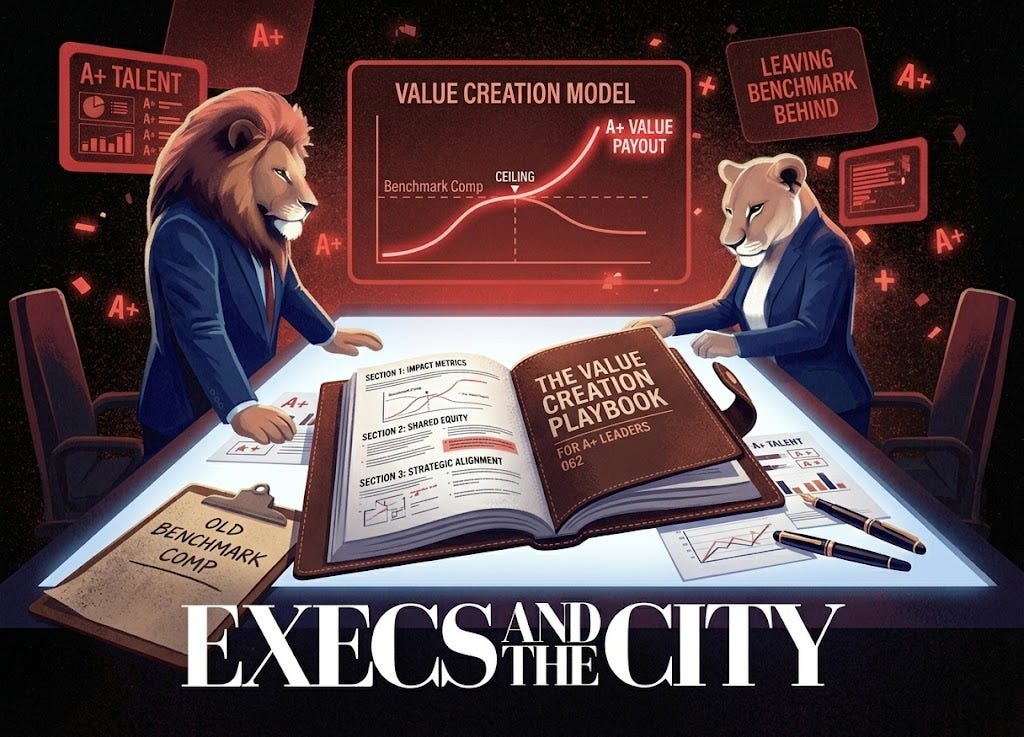
Let me tell you about a deal I almost broke.
A near miss that frustrated everyone.
I was advising a CRO candidate—mid-cap SaaS, $3B valuation, strong growth. The offer was objectively competitive. Top of the band.
Strong equity. Solid bonus target. By every “objective” benchmark, it was a good deal.
She looked at it and said something I’m hearing more and more:
“This comp is built for whoever fills this seat. It’s not built for me or what I’m going to do in it.”
We talked it through.
The deal felt more extractive than creative. It was structured to protect the company’s downside, not to reward her upside.
She knew—because she’d done it twice before—that she could double their annual recurring revenue in 18 months. She had the playbook, the industry-specific relationships, and the track record.
But the offer in front of her priced the role at market rate, not the outcome she’d produce. And it gave her pause.
She wanted a structure that reflected her actual contribution. I agreed. Seems pragmatic.
Long story short—the company lost the candidate.
This is a problem.
The company has spent hundreds of thousands in recruiting costs. Dozens of hours from their most senior leaders. The talent consultancy has spent months building the right slate and guiding the company to their best candidate.
And now—at the finish line—everything stops.
When Cinderella is about to get her slipper, the whole room seizes up.
Buzzkill.
She didn’t know how to advocate for what she needed without sounding like she was asking for a favor—or worse, being combative or difficult.
She had the confidence to deliver a $65M revenue lift but not the language to propose tying her comp to it.
When I offered to create a value-based proposal—she responded with
“What, how? You can do that?”

That gap—between knowing your value and having the words to structure it—is what kills more deals than lowball offers ever will.
Is this a failure in the candidate?
The talent consultancy?
The company?
All three—and it creates a system full of friction that we dismantle one deal at a time.
I’ve watched it happen hundreds of times.
Senior leaders who know they can transform a business but default to “can we bump the base and equity?” Because what else are you supposed to do when everything is locked to band and precedent?
Nobody ever showed them a different frame.
Here’s how deep this goes—when I was researching this article, the AI I use for research and ideation actively discouraged me from challenging standard comp structures.
It kept steering me back toward conventional negotiation tactics. Because the training data is the system—and the system doesn’t have examples of what we’re about to do.

That’s how I know we’re in the right territory.
Creativity doesn’t blossom in the 11th hour when pressure is highest.
And honestly—early in my career—I let a few of those moments pass too, before I understood that the language matters as much as the leverage.
This article is about the language.
If you read the piece two weeks ago, you know what The Performance Signal is—the moment you stop negotiating like an employee and start negotiating like an asset.
If you read last week’s Severance Playbook, you know how to protect the downside before you sign.
This is the how.
The exact scripting, positioning, and tactical framework for proposing milestone-based comp that benefits everyone at the table.
Read the Room Before You Play the Card
Not every company can do this. Not every candidate can pull it off.
And knowing who can is half the battle.
Performance-based comp structures require flexibility—in how the offer is designed, how the board approves it, and how the company thinks about talent as an investment rather than a cost line.
Here’s where this approach has the most traction:
PE-backed portfolio companies. Operating partners think in returns. A comp structure tied to value creation milestones speaks their language. They’re already measuring the executive against a thesis—you’re just asking to participate in the upside when the thesis proves right.
Pre-IPO and high-growth companies. Equity is the currency, milestones are the culture, and the company is actively building the story that makes the stock worth more. Performance-loaded comp is native to how these businesses already operate.
Founder-led companies making their first senior hires. Founders understand betting on yourself. When you say “tie my upside to outcomes,” a founder hears a kindred spirit.
A comp committee at a Fortune 100 hears a headache. (Though we’ve won these over too, they are a pain in the ass and can drag for months. We've got deeper frameworks for navigating the layers here—but that's a longer conversation.)
Companies where the hiring manager or CEO is driving the offer—not just HR. When you’re negotiating with someone who has P&L accountability for the outcomes you’ll deliver, they can see the math. When you’re negotiating with someone whose job is to stay inside the band, the math doesn’t matter.
The following signals tell you the company has flexibility.
The recruiter mentions equity as a conversation rather than a fixed number. The best will do this.
The hiring manager talks about what success looks like in the first year.
The CEO asks what it would take to get you excited.
Board members are involved in the process.
The following signals tell you to tread carefully and build the case over time. Information gathering through curiosity, patience, and timing control become your #1 priority.
Rigid comp bands referenced early and often.
A corporate recruiter who quotes Radford like scripture.
Proxy statement constraints mentioned in the first call.
A process that feels administrative rather than consultative.
“We’re just a startup, you see…”
This isn’t a reason to walk away from those companies.
It’s a reason to negotiate differently—win the base and equity conversations first, then propose what it takes to create a no-brainer after you’ve established your value and the company feels the pull of losing you.
You’re not asking them to break the system.
You’re proposing a pie-expanding opportunity that all parties contribute toward.

But know this—if the execution isn’t precise, this can be reputationally damaging.
You need momentum.
You need to carry learnings from early in the process to substantiate your value proposition.
This isn’t a Hail Mary.
It’s a closing argument built on evidence you gathered from the first conversation forward.
So when the room is right—when do you actually play your hand?
When to Play It
Timing is everything. And the timing is not when most people think.
You don’t introduce milestone-based comp in round one.
Not when you’re expressing your value to the organization.
Not when you’re selling the vacation.
And definitely not as a counteroffer to an unexpected lowball.
You introduce it after three things are true:
The company has committed to you. Not “you’re a strong candidate.” Committed. They’ve told you you’re the one. They’ve asked about your timeline. They’ve introduced you to the board or the team. The emotional investment has been made—and reversing course would cost them more than accommodating your proposal.
You’ve received an initial offer that anchors the base. The base number is on the table. You know their range. You know what they’ve committed to in guaranteed dollars. This matters because the milestone proposal comes as an additive layer—not a replacement for the base, but a structure that sits on top of it.
You’ve already asked the question. Earlier in the process—during the interview dynamic, when information flows freely—you asked: “What are the three outcomes that would make the board consider this hire a home run twelve months from now?”
You documented those answers. Because when the comp conversation arrives, those answers become your milestone architecture.
The sequencing sounds like this:
“I appreciate this offer—it’s competitive, and I respect the structure you’re working within. I look forward to joining you. What’s the chance we can adjust the base and equity? And I’d also love to pair that with a performance structure that makes the overall deal stronger for both of us. I’m no stranger to tying my upside to outcomes—and I suspect that’s one of the reasons we’re all so aligned. Let’s build something neither of us came in expecting.”
You’re not choosing between countering and accepting.
You’re doing something more sophisticated—making reasonable asks on the guaranteed side while simultaneously opening a second lane that makes the total package bigger than a typical negotiation conversation ever could.
The base conversation is familiar territory.
The company expects it.
The milestone proposal is where you change the shape of the deal entirely.
You’re not countering. You’re building. The base adjusts. The milestones are additive. And the first words out of your mouth are acceptance and appreciation—not dissatisfaction.
We’ve made clients millions more per year—and helped companies accelerate their most important initiatives, simply by inviting more creativity and alignment into the negotiation.
And yes—we have a repeatable framework to align all parties.
More on that next week.
Milestones Are Designed Together
A milestone proposal built around your own ambitions looks like a bonus request.
A milestone proposal built around the company’s priorities—informed by everything you learned through the interview process—looks like alignment.
A milestone architecture designed together becomes partnership.
That’s the progression.
And most senior leaders never get past step one. Or really try in the first place.
If you walk in with milestones you invented in a vacuum—revenue targets you’re confident you’ll hit, product launches you were already planning—the comp committee doesn’t see confidence.
They see a rigged game.

You’re asking for a premium on outcomes that were already priced into the role.
But if you walk in with nothing—waiting for the company to hand you the targets—you’ve surrendered the frame. You’re asking them to do your thinking for you.
The move is to propose milestones rooted in what you heard during the process.
The outcomes the CEO kept circling back to.
The board priorities that surfaced in your conversations.
The gaps the hiring manager described when they explained why they needed someone at your level.
You listened.
Now you demonstrate that listening by building a comp structure around what they told you matters most.
“Based on our conversations, it sounds like getting this platform to $150M ARR by Q4 next year is the outcome that matters most to the board. I’d like to propose that if we hit that target together, an additional equity tranche vests. And I’d love your input on refining those milestones so they reflect exactly what success looks like from your side.”
You didn’t invent the goal.
You didn’t wait for them to hand it to you.
You proposed something informed—and then invited them to build it with you.
That’s partnership.
And it’s the moment when people realize that negotiation is not adversarial and scary—but energetic and collaborative.
Does this make the process slower?
Yes.
But it makes the outcome dramatically better—for everyone.
The alignment work that happens in milestone design is due diligence that most hiring processes skip entirely.
You’re pressure-testing expectations, defining success in concrete terms, and surfacing misalignment before day one instead of discovering it at the first performance review.
The companies that complain about a longer hiring process are often the same ones running a replacement search eighteen months later.
This isn’t simply a performance strategy—it’s a retention strategy for both parties.
Double the comp, fired in ten months, eighteen-month search—repeat.
The math doesn’t math—and both sides lose.
You’d have been better off taking half the money at a company that was actually set up for you to succeed.
Getting the job is one thing, keeping the job is another—and conversely—finding high-performing senior leaders is one thing, properly aligning, incentivizing, and retaining them is another animal.
Script A vs. Script B
Let’s make this more tangible.
Script A — What Most Executives Say:
“The offer is solid, but honestly, it’s below what I think I can contribute. I’ve done this before—I took my last company from $60M to $200M in two years. I think my track record justifies a higher number, and I’d like to see the base come up to at least [X] with a stronger equity package.”
This isn’t wrong. It’s what the system taught you to do. And I applaud your courage to push.
But listen to what the comp committee hears.
A candidate who values themselves based on past performance at a different company, asking for more guaranteed dollars with no structural link to future outcomes.
The request is about you—your track record, your self-assessment, your number.
Worse—you’ve got a finger in the air guessing at a higher anchor.

Why that number?
Where did you get it?
If you deliver 2x the revenue for the entire organization, why bump a number up 20-40%? Just cause? That’s not aligned to value creation, that’s only increasing the company’s risk.
Because every candidate they talk to thinks they’re top talent—somebody has to be wrong.
You all can’t be the prettiest girl at the prom.
Value is ultimately subjective.
You want more because you’re supposed to ask for more. And more is better. Right?
And usually you’ll get more because comp committees expect this and budget that into their initial ask in many cases. You’ll just never find the ceiling—so don’t pat yourself on the back too soon.
But the senior leaders who are satisfied with the traditional back-and-forth aren’t the ones reading this.
Another exec who thinks they’re special. We’ve heard this before.
Script B — The Commitment Play:
“I appreciate this offer—it’s competitive, and I respect the structure you’re working within. I’d love to discuss a modest adjustment on the base and equity—and pair that with something I think makes the overall deal stronger for both of us. I’d like us to define 2–3 milestone triggers tied to the outcomes you’ve told me matter most. If we hit $150M ARR by Q4, an additional equity tranche vests. If we close the European expansion ahead of timeline, a cash bridge activates. Your guaranteed cost stays close to where it is. But if I deliver outcomes above the benchmark, the comp reflects that — funded by the value creation, not the budget.”
Script B does something Script A fundamentally cannot.
It accepts the offer.
It signals commitment—gratitude, enthusiasm, intent to join.
You’re not threatening to walk. You’re not manufacturing hesitancy to create pressure. You’re telling them you’re in.
And that’s precisely what makes the milestone proposal so powerful.
You’re making it at the moment of maximum leverage—and using that leverage for alignment instead of extraction. The company isn’t bracing for a fight. They’re leaning in because you just told them you want to be there.
You can still decline later if the structure doesn’t come together—gracefully, professionally, with the relationship intact.
But in this moment, you’re doing something most candidates never do: you’re using your strongest negotiating position to build something collaborative rather than to squeeze.

That alone shifts the dynamic.
You’re not in conflict.
You’re in collaboration—proposing a structure that demonstrates you think like an owner, not an employee negotiating a raise. You heard their priorities and built an architecture around them.
Script A says: “I’m worth more. Pay me more.”
Script B says: “I’m worth more. Let me prove it. And let’s build a structure where proving it benefits all of us.”
One is a negotiation. The other is a business case.
Who would you rather work with?
When They Push Back
They will push back.
Count on it.
Here’s what you’ll hear—and what to say.
“We don’t do that here.”
Most companies will say this first. It’s reflexive, not final.
“I understand that’s not standard—thank you for brainstorming and considering this path with me. I can’t help but feel that the standard structure is designed for a different market. I propose we build something that works to reduce the company’s risk while giving me the opportunity to earn more when we deliver. You pay the premium only in the scenario where we’ve created the value that funds it. In my experience, aligning these milestones across the company incentivizes all teams to perform better—that’s our competitive advantage.”
You must reframe.
You’re not asking them to break precedent. You’re proposing a structure that’s more aligned with the company’s success. It will send ripples through all departments and every high-potential or overachiever will lock in and drive the company forward—because every incremental dollar is performance-contingent.
“Our comp bands don’t allow it.”
“I hear you. What if we stay within the band and structure the performance component as a supplemental agreement? This will give us an opportunity to further align and turn a good deal into a great deal that’s better for everyone.”
The key word is supplemental.
You’re not asking them to violate their comp architecture—or asking them to stick their neck out for someone they just met. That political capital is hard earned and most are not willing to lose it to help you break precedent.
Rather, you’re asking to build an addendum that sits alongside the standard.
Most comp committees have more flexibility in supplemental agreements than they do in base comp—because the supplemental doesn’t set precedent for the rest of the organization.
If you’re worried about being the tall poppy—about being perceived as aggressive or asking for too much—the supplemental path lets you be ambitious without being threatening.
“We’d have to get board approval.”
This sounds like a wall. It’s actually a door.
“That’s a great sign—it means the board would see that I’m willing to bet on myself in ways that help you and them get what they want too. I welcome that conversation.”
A comp committee that brings your proposal to the board is a comp committee that’s already advocating for you.
They wouldn’t surface it if they didn’t want it approved.
The board conversation itself becomes your signal—it tells the entire governance structure that this executive showed up with a business case, not a demand.
“What if you miss the milestones?”
“Then I earned exactly what the original offer proposed—and you got me at market rate. The only scenario where you pay above benchmark is the one where I delivered above-benchmark results. That’s the whole point. Neither of us intends to miss—or we wouldn’t have made it this far in the first place.”
This is the strongest response in your arsenal.
It neutralizes the risk objection completely. Every dollar above the base is funded by outcomes.
The company’s downside is exactly what they were prepared to pay anyway.
If I perform average, pay me average.
If I break the mold, break the mold with me.

Kill the “At Discretion” Bonus
While we’re here.
If your offer includes a performance bonus described as “up to X% of base salary, at the discretion of the board” —you’re holding a coupon that may never be redeemed.
It sounds like a sure thing at signing—but it certainly is not.
You must take this seriously.
When I advise clients on their comp, I include discretionary bonuses in my own fee structure. Real skin in the game. Because the moment your bonus is something we both have a stake in, you start asking the right questions—the due diligence that most candidates gloss over because the bonus feels like a guaranteed add-on.
It’s not.
These are real dollars that real people depend on. And they deserve more than “at discretion.”
Discretionary bonuses give the company maximum flexibility and you maximum uncertainty.
A banner year where you crushed every metric?
“We’re being conservative with bonuses across the organization.”
You’re kidding me—again?!
You’ve lived this. We all have. We’ve grown to expect it.
The fix isn’t a higher discretionary percentage. It’s replacing “at discretion” with defined triggers.
“I appreciate the bonus structure. Can we define 2–3 specific outcomes that qualify for the full payout? That way we’re both clear on what success looks like—and neither of us is guessing.”
You’re not attacking the structure.
You’re upgrading it from an ambiguous promise into a contract.
And most comp committees want this—defined triggers make their job easier when justifying the payout to the board.
Discretionary bonuses persist not because companies prefer ambiguity—but because nobody asked them to be specific.
The senior leaders who ask are the ones who collect.
The Lowball Application
What about when the offer isn’t competitive?
When the number is genuinely below market and you know it?
The milestone architecture becomes even more powerful.
Most executives respond to a lowball one of three ways. They walk. They swallow it and resent it. Or they go fractional— “If you can only pay me X, I’ll give you X worth of effort.”
I’ll sometimes advise this path when the fit is right.
But it’s trickier than it looks.
Go fractional without precision and you’ll be perceived as a contractor—a mercenary for hire. You’ve capped your ceiling.
You’ve given them permission to treat you as an operating expense instead of a capital investment—and guaranteed that every conversation about your contribution will be measured in hours or billable days instead of outcomes.
The commitment play works differently.
Accept the lower number—if palatable—and propose milestone triggers that bridge the gap between their offer and your real value.
“I understand the range you’re working within. I’ll accept the guaranteed comp as structured. But I’d like to propose that we tie an additional tranche to the outcomes we’ve discussed. If I deliver [specific board priority], the milestone tranche brings my total comp to where I believe it should be — funded by the value I created, not additional budget.”
You just turned a discount into an accelerator.
You absorbed uncertainty the company would otherwise need to resolve with higher guaranteed dollars. That risk transfer earns a premium. The milestone tranche shouldn’t just close the gap—it should exceed it by 25–50%.
Because you made their economics better in every scenario. And the only scenario where they pay the premium is the one where you massively overdelivered—which means they’re thrilled to write the check.
This Structure Is a Filter
Let’s be honest.
This isn’t for everyone. It’s meant to be a filter.
The executive who proposes milestone-based comp has to deliver.
The structure exposes you if you can’t.
It’s not simply naive confidence.

There’s no hiding behind a guaranteed package when your incremental comp is tied to outcomes with deadlines and dollar values attached.
The same filter works on the company side.
A business that accepts a milestone proposal has to be sophisticated enough to define meaningful targets, measure them honestly, and honor the triggers when they’re hit.
The executives who propose this signal to the market: I perform.
The companies that embrace this signal to the market: We reward performance.
When those two signals meet, you get something neither side can achieve alone—a comp architecture that attracts, retains, and motivates at a level that benchmark-driven competitors cannot match.
That’s not a negotiation.
That’s a competitive moat—for both sides.
Your Move
If you’ve followed this series the last three weeks, you now have the architecture—why the market is shifting, how to protect the downside, and now the language to propose the upside.
If you’re heading into a negotiation in the next 90 days: ask the question early.
Document what the board considers a home run.
When the offer arrives, counter with a structure, not a number.
Frame it as alignment.
And negotiate the severance before you sign.
Your career is the largest financial asset you’ll ever manage. Build the deal accordingly.
And when you’re sitting across from the comp committee, remember—you’re not asking them to bet on you.
You’re showing them what it looks like when someone bets on themselves.
Everything I’ve written in this series has been for you—the senior executive.
But here’s what I’m increasingly hearing from the other side of the table:
The compensation conversation is shifting.
The smartest companies are figuring this out.
They’re redesigning compensation architecture not simply because they’re losing top talent—but because they’ve realized that performance-based structures attract better talent, retain them longer, and align every stakeholder around the same outcomes.
Next week, I’m writing a piece for the companies. Because the executives who read this aren’t the only ones who need to hear it.
When both sides build toward the same structure, everyone wins.
Ready to discuss your career? Book a strategy session.
Stay fearless, friends.