

A Recent $10M+ Deal Shows Where Executive Comp Is Heading
Traditional packages assume performance. Milestone pay proves it.


The senior leaders making the most money right now are the ones who asked to get paid less.
Less guaranteed, that is.
From the massive bull market push from ‘08 to ‘20—the COVID hiccup—to the frenzy of inflated activity from ‘21 to ‘24—executive compensation rode a wave that made everyone feel like a genius.
Packages went up because everything went up.

That wave broke.
The last two years have presented a split I’m watching play out in real time across my client base.
On one side—many leaders are feeling defeated and accepting the downward pressure. Settling for deflated packages. Negotiating the same base-bonus-equity structure they’ve always negotiated, just with smaller numbers.
The echo chambers in leadership communities have grown deafening—the downtrodden reinforcing the narrative that this is just what the market pays now.
On the other side—confident senior leaders who get creative.
Who stop negotiating the number and start negotiating the structure. Who propose tying their comp to milestones—and end up making more than they would have in the bull market.
Assuming, of course, that they are as capable as they purport to be.
In a market anticipating poor performance and reducing pay because of it—the true A+ talent is willing to bet on themselves.
I recently helped restructure a Fortune 500 leadership team’s compensation—multiple senior leaders—where we lifted their combined comp north of $10M annually around this exact model.
The old structure was failing everyone—and made top senior leaders ripe for poaching by the competition.
And the competition came aggressively knocking, right after the CEO made public announcements during quarterly earnings calls.
A cutthroat trend that’s increasing during the nuclear arms race to see who wins these AI dollars.
The new structure saved the company between $300M to $500M in value that would have evaporated if even one of those leaders walked during a critical period—and stripped the team out with them—and it put life-changing money in my clients’ pockets.
But this only works if you understand why the traditional structure is designed against you in the first place.
Traditional Structures Fail Everyone
Most people don’t realize that the standard executive comp package is not designed to reward performance. It’s designed to reduce uncertainty and get the deal done quickly.
Base. Bonus. Equity. Four-year vest.
That structure optimizes for presence. Not impact. Not value creation.
For the senior leader:
Every leader walking into a negotiation believes they’re top talent. Very few are willing to back that up with their comp structure. They’d rather take the guaranteed package—higher base, predictable (ish) bonus, time-based equity—and avoid the risk of being measured.
I get it. That instinct is human. Your nervous system doesn’t want uncertainty attached to your paycheck. It wants safety.
But here’s what that safety costs you.
When you crush it in Year 1—when you drive $50M in new revenue or turn around a failing division—what changes in your comp?
Almost nothing.
Your bonus might tick up. Your equity continues its glacial four-year vest. The value you created is captured by the company instantly while you wait years to see a fraction of it.
You’re bearing the execution risk with almost none of the execution upside.
And when it doesn’t work out—when the organization wasn’t ready for what you were hired to do, when the board shifts strategy six months in, when the culture rejects the change agent they recruited—you’re the one explaining a short tenure on your resume.
The guaranteed package didn’t protect you. It just made the failure more expensive to unwind.
For the company:
Hiring the wrong senior leader is one of the most expensive mistakes an organization can make. And the traditional structure makes that mistake maximally painful.

You’re paying full freight from Day 1—guaranteed base, sign-on bonus, equity grants—before you have any evidence the person can deliver in your specific environment.
If it doesn’t work out in 10 months, you’re not just out their comp.
You’re out the recruiter fees, the onboarding cost, the teams they hired who may not survive the transition, the strategic initiatives that stalled, the institutional knowledge that walked out with the predecessor they replaced.
Average executive tenure is shrinking. The cost of a miss is going up. And in this market—where the margin between winning the AI race and becoming irrelevant is measured in quarters, not years—a bad senior hire isn’t just expensive. It’s existential.
The traditional package absorbs none of that risk. It front-loads cost and back-loads accountability.
For the talent firms who place them:
When a firm places a senior leader into a role and that leader doesn’t work out—the firm doesn’t just lose a fee. They may lose the relationship.
Many executive search firms guarantee placements for 12 months. A miss means running the search again on their own dime. But the real cost isn’t the redo—it’s the reputational damage.
The board remembers who brought them the wrong person. Future mandates dry up. Referrals disappear.
A milestone-based structure changes that math.
When all sides define what success looks like before the offer letter is signed—when comp is tied to specific outcomes—the quality of the match goes up. The risk of a bad placement goes down.
There’s a reason advisory firms are circling this space right now. The model is shifting—and the firms that help architect these structures will own the next era of executive placement.
Counterpoint—And Why It’s Actually the Point
The objection I hear most from HR leaders and comp committees is that milestone-based structures take longer to negotiate.
More conversations. More alignment. More complexity.
They’re right. It does take longer.
That is exactly the point.
Companies and senior leaders need to have smarter conversations about what they actually need.
Not vague job descriptions and “at discretion” performance bonuses that nobody can define. Real alignment on what value looks like, what the milestones are, what triggers the upside.
When someone has a meaningful portion of their compensation tied to specific outcomes, they care more about performing. If they don’t perform, the company pays less. If they over perform, the company pays more—and gets dramatically more in return.
This isn’t a new concept.
It’s how every sales organization on earth works.
Close the deal, earn the commission.
But this isn’t commission. Commission rewards transactions. What I’m talking about is rewarding value creation—strategic outcomes, not activity.
We’re not building coin-operated executives.

We’re building compensation architectures where both sides have skin in the game and the incentives are aligned to real value—not a legacy model that persists because that’s the way it’s always been done.
The system resists change—including paying you differently—because the system is designed to protect itself.
That’s Institutional Homeostasis.
And the executives and companies breaking out of that model are the ones winning right now.
The Proof Is Already Here
If you think milestone-based comp is experimental, you haven’t been paying attention.
The Brady Model
When Tom Brady left the Patriots in 2020 and signed with Tampa Bay, the contract was a two-year deal worth $50 million—fully guaranteed. No-trade clause. No franchise tag.
He could have stopped there. He was 42 with six Super Bowl rings. Nobody would have questioned a straight guaranteed deal.
But Brady volunteered to tie an additional $9 million to performance incentives. Up to $4.5 million per year—triggered by top-five finishes in passer rating, touchdowns, yards, completion percentage. Separate triggers for playoff appearances and the Super Bowl.
A player with maximum leverage chose to make part of his compensation contingent on outcomes.
Why?
Because Brady understood something most don’t. When you tie your comp to performance, you aren’t taking a risk.
You’re sending a signal.
You’re telling the other side: I’m so confident in what I’ll deliver that I’ll let you pay me based on results.
The Buccaneers didn’t hear “discount.”
They heard “all in.”
Brady also has the personality to put big hairy goals out there to stay driven—to fuel heavy workouts while his bones beg for him to do anything else.
He won the Super Bowl in Year 1.
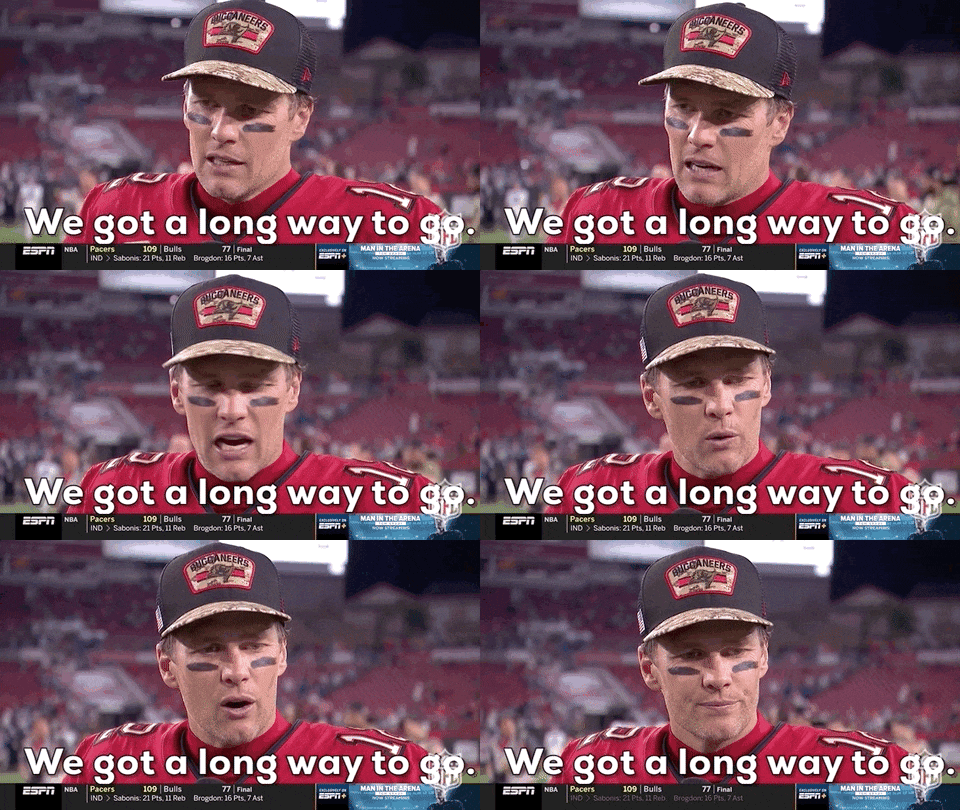
Collected the max.
But the incentives weren’t about the money. They were about positioning—telling the organization and the league that he was playing to win, not playing out a contract.
The $250M AI Researcher
Now look at what’s happening in tech.
Meta offered a 24-year-old AI researcher a package worth $250 million over four years—with the potential to earn $100 million in Year 1 alone.
Multiple researchers moving from OpenAI to Meta’s Superintelligence Labs are getting packages in the $100M to $250M range—structured not as salaries but as layered deal architectures with performance conditions, milestone payments, and retention triggers tied to what they actually deliver.
These aren’t comp packages. They’re talent deals.
The stakes are big time right now.
This is how Hollywood has structured talent for decades. How professional sports contracts work. How producers, show runners, and A-list performers get paid—not a flat salary, but a layered architecture of guarantees, bonuses, backend participation, and milestone triggers.
And it’s migrating into the corporate executive suite.
The Rise of Executive Representation
I’m seeing a growing number of executives hand off their negotiations to employment lawyers, advisors, and—in some cases—what can only be described as agents.
Not just for severance. For the entire deal structure.
This is a tectonic shift.
Employment lawyers are the downside folks.
They’re thinking about the divorce—severance protections, termination clauses, non-competes, what happens when things go wrong.
That work matters. Every executive should have it covered.
But most executives stop there.
What I do is the upside.
I’m thinking about the marriage—how to structure the deal so that when things go right, you capture the value you created. Milestone triggers. Performance-based equity acceleration. Comp architectures that reward outcomes, not just presence.
For the talent. For the company. For the talent firm.
I’d argue that you should think this way as well. It’s a much more collaborative and “pie enhancing” mindset.
The downside folks protect you from losing.
The upside folks help you win.
When a senior leader says “let my team handle the details”—they’re not being lazy. They’re being strategic.
They keep their hands clean with the future employer. They maintain the relationship. And their representation fights for protections, milestones, and guarantees that the executive would never ask for directly.
It’s the same reason every professional athlete and A-list entertainer has an agent and a lawyer. The talent focuses on the work. The team architects the deal.
The Fortune 500 is starting to operate the same way.
The Structure Is the Strategy
There’s a name for what happens when you propose tying your comp to outcomes.
I call it The Performance Signal.
It’s the moment you stop negotiating like an employee and start negotiating like an asset.
When you ask for a bigger base, the company hears cost.
When you propose milestone triggers, the company hears confidence.
Same financial outcome. Completely different narrative.
The market is moving here whether you are or not.
AI talent contracts that mirror Hollywood deal structures.
Executives bringing in advisors to architect their deals.
Comp committees experimenting with trigger-based equity because the old model isn’t retaining anyone worth keeping.
The only question is whether you move first—or spend another cycle negotiating base salary increases that don’t compound and equity grants that vest on a calendar, not on value.
I touched on this briefly in my conversation with Lenny Rachitsky.
In the coming weeks, I’ll break down the exact playbook—how to identify the right milestones, how to propose them without sounding like you’re gambling, and how to build a comp architecture that rewards what you actually deliver.
Next week—a special paid-subscriber edition: the exact severance negotiation playbook every executive needs before signing. Upgrade to paid, I’m bumping the tier cost in April.
For now, sit with this question:
If you’re not willing to bet on yourself—why should the company?
Ready to discuss your career? Book a strategy session.
Stay fearless, friends.
The comp committee perspective is the missing piece here. Most boards still approve time-based vesting because it is simple to model and simple to explain to shareholders. Milestone structures require the board to define what success actually looks like before the hire starts, and that conversation exposes how few boards have done the strategic work to know.