

The Severance Playbook—Negotiate Your Divorce Before the Wedding
I’ve kept this behind closed doors because it’s worth tens of thousands in practice. This is the first time I’m putting the full playbook in writing.

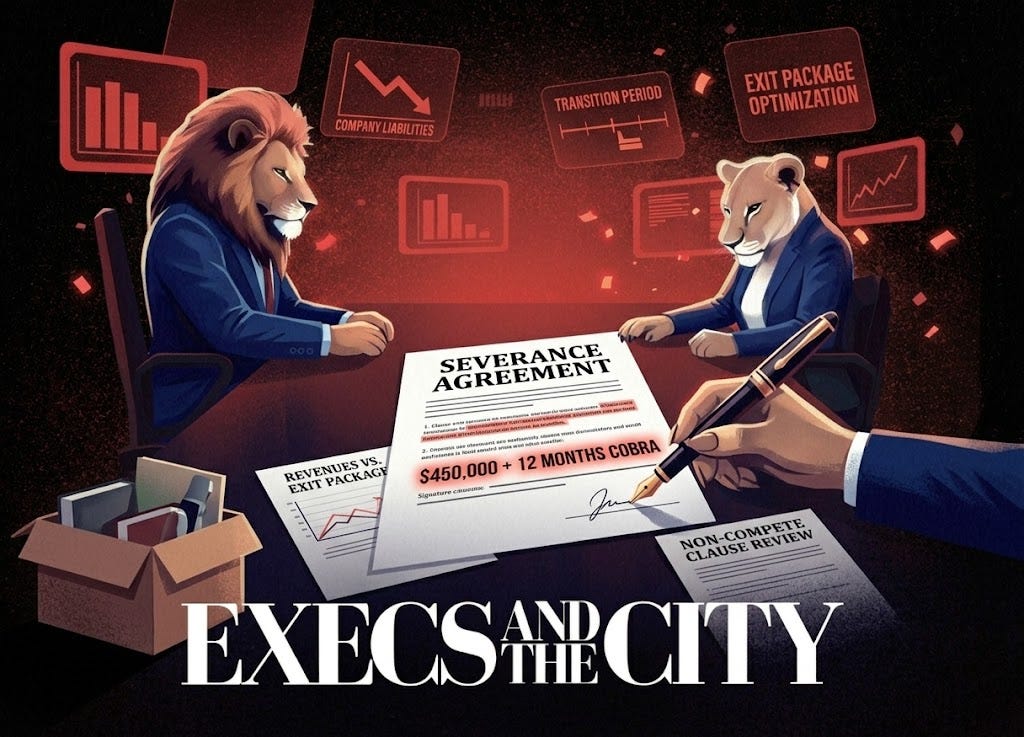
Too many senior leaders only think about severance when they’re already out.
The conversation usually starts like this: “Jacob, I just got let go. What can I do about my severance?”
And the answer, usually, is—not much.
We often get something.
But never as much as we could have—and never without the emotional wreckage that follows the deed being done.
The time to negotiate your safety net is before you need one.
Before you’ve signed anything.
Before you’ve emotionally committed.
Before the company knows you’re a sure thing.
Negotiate the terms of your divorce before getting married—when everyone is supportive and full of love.
Because the moment you sign that DocuSign, you’ve surrendered the single greatest source of leverage you’ll ever have in that relationship—the ability to walk away.

I’ve learned across thousands of negotiations that severance isn’t a perk.
It’s a risk mitigation strategy—because you typically pay the brunt of the reputational and financial hardship post termination.
Far more than your organization does.
Especially if you were recruited away from a role where your livelihood and career were relatively safe.
Severance is a structural component of any serious executive compensation package. And the executives who treat it that way—who expect it rather than ask for it—are the ones who walk away protected when the inevitable happens.
And the inevitable always happens.
Why Nobody Talks About This
You just got the offer. The title is right. The comp looks strong.
Your brain is doing what it does after every win—flooding you with the same chemistry that makes you feel invincible after closing a major deal or nailing a board presentation.
Bringing up severance in that moment feels like handing your fiancé a prenup at the rehearsal dinner.
So you don’t.
And that’s exactly what the system is counting on.
Companies aren’t being malicious.
But they understand something you don’t in that moment—that the emotional high of a new offer is the worst possible time for rational financial planning.
The part of your brain responsible for long-term strategic thinking goes quiet when the part responsible for “they picked me” is running the show.
Especially in an employer market.
This is Institutional Homeostasis doing what it does best.
The organization’s immune system resists building protections for your departure during the same conversation where they’re investing in your arrival. It introduces friction. It forces both sides to acknowledge something uncomfortable—that this might not work out.
But here’s what separates the executives who walk away whole from the ones who call me too late—the willingness to have the uncomfortable conversation while everyone is still in love.
Because we’re all adults here.
And adults who’ve led organizations and made decisions that affect thousands of people can handle an honest conversation about protection.
The Leverage Curve
Severance isn’t one-size-fits-all.
There’s a curve—and the more senior you are, the steeper it tilts in your favor.
At the Director level, 3 months is standard.
VPs should target 6 months as a baseline—and push for it without hesitation.
C-suite executives should be looking at 6 to 12 months.
And in the right circumstances—particularly when you’re being recruited away from a stable, high-paying role—we’ve secured 18 to 24 months.
These numbers are generalities—I’ve seen directors get a year and C-suite get 10-year early pension packages.
Never use these as a reason to avoid getting creative.
I’ve also seen leaders negotiate a clause that reads: 6 months of guaranteed severance with 1 additional month added for every year of continuous employment with the company.
The logic is straightforward.
The more senior the role, the harder the landing if it doesn’t work out.
A CMO who gets let go 10 months in doesn’t just lose hundreds of thousands in income.
They lose 10 months of career momentum.
They lose the equity they left vesting at their previous company.
They lose the reputational capital that comes with stability—and inherit the reputational tax that comes with a short, unexplained tenure.
That’s not a one-month-of-base-salary problem.
And this is where most senior leaders get the math wrong.
They think about severance as a function of their new role. It isn’t.
Severance is a function of what you’re leaving behind.
If you’re sitting in a stable position—equity vesting on schedule, bonus trajectory known, institutional credibility compounding—and a company asks you to walk away from all of that, they’re asking you to absorb risk.
Real, measurable, career-altering risk.
Add a cross country move or pulling you into the office full time and we’ve got a lot of life altering changes to consider.
The signing bonus is supposed to bridge that risk.
But most executives treat it like a gift instead of what it actually is—an insurance premium on the career capital you’re forfeiting to take the bet.

Most senior leaders fail to win a signing bonus in the first place. That’s a problem worth its own piece.
The severance package is the backstop.
It’s the thing that ensures you’re not financially devastated if the bet goes wrong—not because you failed, but because the board shifted strategy. Or the CEO who recruited you left a week later. Or the company got acquired and your role was eliminated before you finished onboarding.
I’ve watched all three happen in the last 12 months. To people who are very good at what they do.
The risk isn’t theoretical. The protection shouldn’t be either.
Here’s exactly what to do to win.
