

Executive Loneliness: Why Climbing Higher Means Feeling Lonelier (And How to Fix It)
Why climbing higher often means feeling lonelier—and how the most effective leaders are reclaiming their humanity through intentional community and connection.


Last week, we established that silence is a competitive advantage. We discussed the strategic necessity of “going dark” to regain your cognitive edge.
But silence has a dark side.
If you strip away the noise, the titles, and the frantic motion... what is left?
For many executives, the answer is terrifying: Nothing.

I especially felt this way as the CEO of Discover Podium. Every personal relationship suffered while I gave everything to leading the company for 5 years.
We have built a generation of leaders who are professionally successful and socially bankrupt.
We call it “lonely at the top,” as if it’s a noble sacrifice—especially in America.
It isn’t. It is a structural failure.
Isolation is not just an emotional state; it is a biological malfunction.
When a primate is isolated from the troop, cortisol spikes because they are vulnerable to predators. In the boardroom, this manifests as hyper-vigilance, paranoia, and the inability to trust your own judgment.
Maybe this is why hostile private equity takeovers and RIFs that impact tens of thousands can be just another Tuesday afternoon to an executive tasked with making the numbers work for shareholders.
You cannot lead effectively when your nervous system is convinced it is under siege.
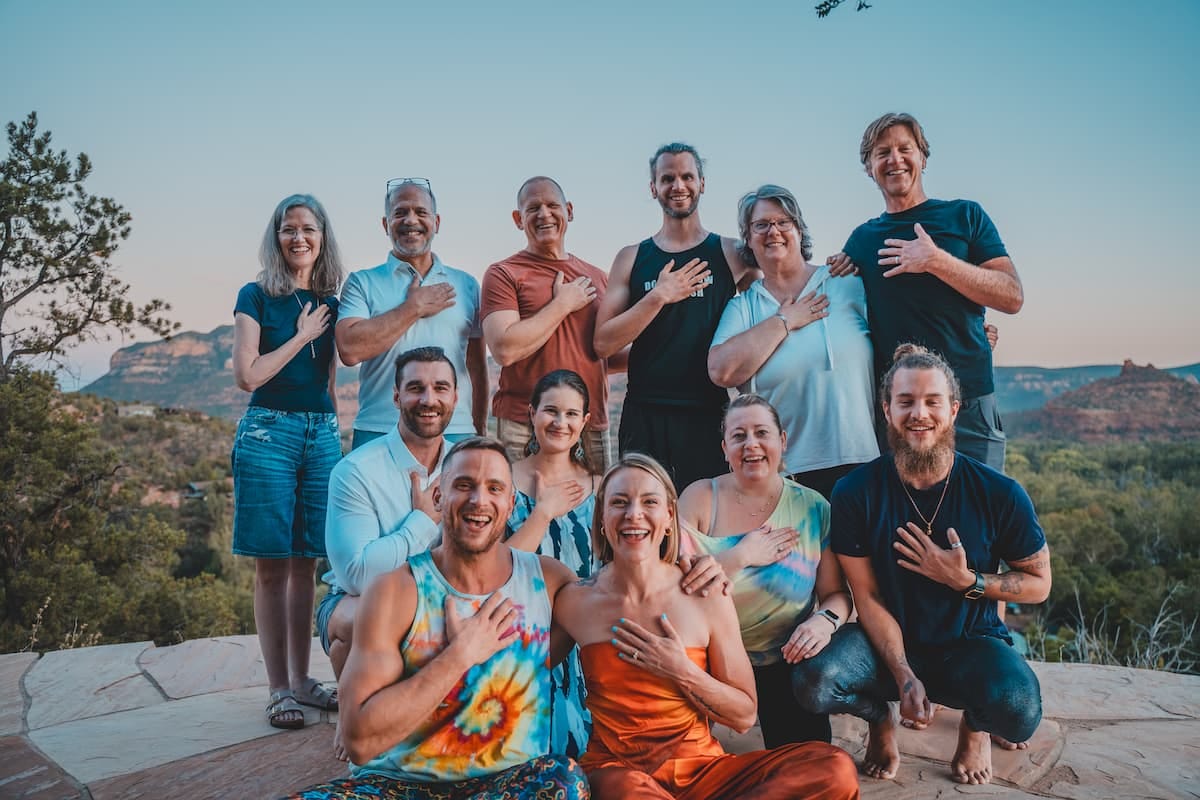
To fix this, I’ve brought in Chelsea and Jack, co-founders of Becoming the Bridge.
They don’t just teach community; they teach biological reconstruction.
Here is how to rebuild the tribe you sacrificed to get to the corner office.

“My entire identity is tied up in my career… and it doesn’t feel good anymore.”
This wasn’t the first executive we’d heard this from. A classic example of “what got you where you are won’t get you where you’re going.” And it won’t feel good if you try to force it either.
How do you get unstuck?
Intentionally surrounding yourself with a community of people who will shake you from patterns and call out the best in you. Support you through peaks and valleys. And make it easy for you to remember who you are.
But that doesn’t come naturally in our corporate careers.
The Biology of Co-Regulation
Neuroscience introduces us to the concept of Co-Regulation.
Humans are open-loop biological systems. We cannot regulate our nervous systems entirely on our own; we need others to stabilize us.
A dysregulated nervous system (high stress, fight-or-flight) cannot calm itself down solely through willpower or meditation apps. It requires the presence of a regulated nervous system to mirror safety.
This is why the “Lone Wolf” leader is a biological myth.
You literally cannot access your highest cognitive functions—like complex strategy and moral reasoning—without a tribe to anchor your biology.
Without that anchor, you aren’t just lonely. You are cognitively impaired.
What begins as ambition becomes entanglement.
What starts as drive can morph into self-definition.
And without realizing it, the ladder you’ve climbed has narrowed your world.
The Cost of a Career-Rooted Identity
When our identities become fused with our achievements, several things begin to happen that we don’t always notice in the moment:
Our social circles shrink.
People know our title before they know our heart.
Imagine a senior leader who realizes that most conversations begin with “How’s Q3 looking?” rather than “How are you holding up?”
Their connections become narrower and more transactional, even as their visibility rises.
We stop being witnessed as humans.
Conversations become transactional—metrics, goals, restructures, performance. When you try to mention a personal challenge, the discussion snaps back to KPIs.
Not out of malice—just out of our cultural momentum.
Over time, we stop bringing our humanity into rooms where it never seems to fit.
We lose access to diverse reflection.
We’re surrounded by people who reinforce who we’ve been, not who we’re becoming.
When we crave more purpose—we often keep getting the same advice—accelerate, scale, push—because our circle reflects the identity they’ve historically performed, not the one we want to grow into.
Our emotional range compresses.
The stakes feel higher, the pressure intensifies, and vulnerability gets quieter.
We will default to “I’m good” even when we’re depleted. We believe steadiness is required at all times, and slowly our emotional landscape narrows to “fine” and “under control.”

Our sense of fulfillment dulls.
Even massive success feels strangely muted when there’s no one who really sees you.
A career-defining win lands with a thud because the people celebrating see the outcome, not the human experience behind it.
White-knuckling it alone isn’t just unsustainable—it’s detrimental. Mentally, emotionally, even physically.
And it’s easy to distract ourselves.
There is always another board deck, another flight, another fireside chat, another spreadsheet calling for updates. But there is a cost when we make more time for our dashboards than our inner landscapes.
If you’re not giving your soul as much attention as your spreadsheets, eventually something starts to ache.
Because work—no matter how impressive—is not meant to replace your humanity.
Two Strangers Asking the Same Question
Hi—we’re Chelsea and Jack.
Long before we knew each other, we were living parallel lives—VP titles, President’s Club, hypergrowth metrics, and a quiet desperation we medicated with alcohol and motion.
Jack found his turning point in rehab and then a retreat in Costa Rica. Chelsea found hers when the pandemic stripped away the stage and she took a leap of faith with a retreat of her own.
Both of us stopped performing and started asking:
Who am I without the armor?
Maybe you have felt this way too.
We both sought something deeper.
Steps to Reconnect With Your Whole Self
You don’t need a sabbatical or a spiritual pilgrimage to change your experience of leadership.
You need intention—and a few practical steps.
1. The Relationship P&L (Social Audit)
Most executives treat their energy like an unlimited resource. It isn’t. You need to audit your relationships with the same rigor you audit your financials.
Open your calendar. Look at the last 10 people you met with outside of immediate direct reports.
Who is an Asset? Who leaves you feeling clearer, sharper, and more regulated?
Who is a Liability? Who leaves you drained, defensive, or needing a drink?

Stop treating energy vampires like necessary expenses.
They are bad debt. Write them off.
You need to ruthlessly curate the people who have access to your nervous system. If they reinforce your armor, they go. If they speak to your humanity, they stay.
2. The ROI of Time (Energy Audit)
Your calendar is a mirror. It reflects what you truly prioritize, not what you say you value.
Where are you getting a return? Identify the moments where time moves quickly because you are in your “Zone of Genius.”
Where are you bleeding? Identify the moments where you are performing a version of leadership that no longer fits.
Many leaders realize the work they are “known for” is the work that is killing them.
This audit isn’t about time management; it’s about energy management. If you are operating from an empty tank, your strategy is worthless.
3. Make Time for Your Soul
Leadership is not just about strategy. It is about alignment.
Even the most precise Social and Energy Audits will fall flat if there is no space where you can meet yourself honestly.
This does not require a monastery.
It can look like ten minutes without your phone, a weekly walk without headphones, a monthly hour with someone who knows you beyond your title.
The question underneath all of this is simple:
Do I like who I am becoming in the way I am currently leading?
If the answer is “not quite,” you are not broken. You are simply ready for a different way.
Social Audits, Energy Audits, and Soul Time are basic practices, but for most executives, they are radical. They create the conditions for you to lead not only more effectively, but in a way that actually feels good to live inside of.
How This Might Look Moving Forward
We see time and time again when leaders reconnect to your inherent worthiness, rediscover their vision, and expand into new possibilities—through community, coaching, and the transformative power of being deeply seen—all of the best things in your life become available.
We’ve experienced firsthand how isolating leadership can be—and how profoundly life-changing it is when you’re no longer carrying it alone.
You can grind your way to the top, but you cannot grind your way to fulfillment.
Your career can be extraordinary. Your leadership can be impactful. But you cannot do it alone.
Stop trying to be the hero. Start building the tribe.
Jacob’s Take
There is a pervasive lie in executive culture that says dependency is weakness.
We convince ourselves that if we just work harder, optimize more, and sleep less, we can outrun our biology.
We treat “community” as a soft “nice-to-have” that we will get around to once we exit or retire.
Or it’s just a gimmicky collection of semi-lookalikes networking to find a job.
As I wrote last week, the market pays for your clarity, not your stamina.
And as Chelsea and Jack just proved, you cannot have clarity if your nervous system is constantly scanning for threats because you are isolated.
If you are looking for a tactical reason to care about this, here it is: Isolation is expensive.
It costs you your judgment. It costs you your resilience. And eventually, it costs you the very career you are sacrificing everything to build.
You would never run a company without a Board of Directors to check your blind spots. Why are you trying to run your life without one?
Stop giving your most limited resource—your energy—to people who treat it like a free commodity. Be as rigorous with who you let into your life as you are with who you let onto your cap table.
Winning alone isn’t winning.
Go find your tribe.
Connect with Chelsea and Jack on LinkedIn to learn more about their executive cohorts at Becoming the Bridge.
Ready to discuss your career? Book a strategy session.
Stay fearless, friends.
 | A guest post by
|
 |
|