

Why "Unlimited PTO" is a trap
Why the most sought-after leaders use strategic boredom to reset their psychology, reclaim their health, and command higher offers.


“Unlimited PTO” is one of the most brilliant psychological tricks in the modern corporate playbook.
On paper, it looks like freedom.
In practice, it weaponizes the psychological principle of social compliance.
When no specific boundaries are set, high-performers default to the group norm—which is usually to work until they collapse.
Research consistently shows that employees with “unlimited” policies actually take fewer days off than those with fixed allocations. You don’t take the time because you don’t know how much is “safe” to take without signaling a lack of commitment.
This is a microcosm of a much larger executive leadership pathology.
We have convinced ourselves that silence is a threat.
If you aren’t visible, you aren’t valuable. If you aren’t responding to Slack at 9 PM, you’re losing your edge. We treat a gap on a resume like a criminal record—something to be explained away or hidden in the fine print.
But this “always-on” mentality destroys the very asset you sell: your judgment.
Further, it destroys your faith. Your health. Your marriages. Your families.
And yet, it feels like a socially acceptable failure point—doesn’t it? The interviewer asks, “What’s your greatest weakness?” and you offer a beguiling smirk:
“Working too hard? Caring too much?” Chuckle chuckle.

We treat it like a badge of honor. But let’s call it what it is.
Many of my readers know that I’m a recovering workaholic. I know the drive comes from trying to prove something to someone—likely stemming from the substance abuse connected to my childhood trauma. I am obsessive to a fault—and I have turned these obsessions on leadership psychology to scratch the itch.
I’m no therapist, but what I find interesting is that many of my clients are doing the same thing. I didn’t expect to find solace in that shared struggle.
I’m a growing advocate for mental health and those battling their demons of substance abuse. And I can’t help but see the parallel with our executive counterparts.
Do we need to create a Workaholics Anonymous?
Our obsessions remind me of the lyrics from Sober by Tool:
Trust in me and fall as well I will find a center in you I will chew it up and leave I will work to elevate you Just enough to bring you down
We have centered our entire lives—our personal identity and self-worth—on the success of our careers rather than the content of our character.
And it elevates us just enough to bring us down.
Cognitive psychology confirms this leads to decision fatigue.
Roy Baumeister’s research demonstrates that willpower and executive function are finite resources. Every time you check an email, scroll LinkedIn, or react to a notification, you burn glucose. You deplete the neural resources required for high-stakes problem solving.
Most leaders I meet are operating in a state of chronic cognitive debt. They believe they are demonstrating work ethic. In reality, they are demonstrating a lack of control.
My hands are red just as much as yours. But we have to face the math—the market does not pay a premium for your stamina.
It pays for your clarity.
And perhaps that’s the problem. We’re always centering our value on what capitalism deems valuable so we can provide for our families—capitalism clearly doesn’t value the health and wellbeing of fellow man.
But even by the cold logic of the market, we are failing.
The market pays for your ability to synthesize complex information and make the one decision that moves the needle and pays back shareholders. You cannot do that when your brain is in a permanent state of reactive overstimulation.
The executives who command the most compelling offers—the ones securing 50% to 100% compensation jumps—are rarely the ones who jumped from role to role without a pause.
They are the ones who had the courage to go dark.
They understood a fundamental truth about power dynamics—boredom is not a liability. It is a competitive advantage.
Panic in Silence
Last year, a Chief Marketing Officer came to me in a state of manic optimization.
She had just been laid off from a high-pressure role and was terrified of the white space on her calendar—and the gap on her resume that felt like a career death sentence.
She decided to treat her job search like a combat operation.
She was rewriting her LinkedIn summary at 11 PM—and doomscrolling until 2 AM. She flirted with the concept of becoming a “LinkedIn Influencer” (then threw up in her mouth and thought better of it). She was forcing coffee chats with people she didn’t like to discuss roles she didn’t want.
She was checking her email every ninety seconds, waiting for the dopamine hit of a recruiter reaching out.
She told me she just needed a “better narrative.”

I told her she needed to go dark.
I prescribed a mandatory three-week executive blackout. No LinkedIn. No email. No “exploratory calls.” No podcasts about leadership. I hear Hawaii is nice this time of year.
Her reaction was visceral. It wasn’t just hesitation—it was panic.
“If I step away for three weeks, the pipeline dries up. People will forget me. I’ll lose momentum.”
This is the lie the addicted brain tells the executive. If you don’t get your next hit—how are you going to feel anything meaningful again?
We conflate momentum with velocity.
She was moving fast, but she was running in circles. She was so busy trying to fit herself into the market’s existing boxes that she had no capacity to build a new one.
Worse, this “always-available” energy repels rather than attracts. It signals desperation, not exclusivity. It violates the basic laws of supply and demand—if you are always available, you are not in demand.
The first week of a sabbatical is not peaceful. It is painful.
My clients often report physical symptoms similar to withdrawal. The phantom buzz of the phone in the pocket. Spikes in cortisol. A nagging sense of guilt that whispers, you should be doing something.
This is your brain fighting to stay in the Task Positive Network, the neural state focused on execution and to-do lists. It’s your comfort zone.
But if you can push past the panic, something shifts around day ten.
The noise settles. The urge to check the phone dissipates. And for the first time in years, the Default Mode Network (DMN) comes online.
Neuroscience tells us the DMN is responsible for autobiographical memory, future envisioning, and distinct moral reasoning. It is the only state where the brain can connect disparate ideas to form a cohesive strategy.
It is biologically impossible to access this state while checking Slack—or worse—Teams.
By week three, my client didn’t just “feel better.” She thought differently. Perhaps it was finally getting a full night’s sleep or the long healthy walks on a sunny beach that refilled her Vitamin D stores after being nutrient deficient for months on end.

She realized she was chasing another CMO role out of habit, not intent.
The silence allowed her to recognize that her actual value wasn’t in functional marketing—it was in restructuring go-to-market teams for acquisition.
She returned to the market not as a desperate candidate looking for a job, but as a rested asset offering a specific solution.
The result?
She stopped interviewing for lateral moves—and stopped feeling the pressure to land with urgency. She stopped worrying about how the last role didn’t work out and focused on the future value she could create.
Her new leverage helped her not just land a new position, but align a cash compensation that was over 40% higher than her previous role. Plus whatever the funny money equity turns out to be.
Many other executives lose leverage after a layoff. They signal desperation and accept lesser roles for lesser compensation—especially in our current constricted market.
She failed forward. Big time.
The clarity didn’t come from a resume writer or a LinkedIn tweak to attract inbound attention. It didn’t come from a framework or some scaffy post from a wannabe AI influencer on LinkedIn.
It came from the terrifying, necessary act of being bored long enough to hear her own thoughts and recognize the opportunity for what comes next.
Gratitude followed. Anxiety diminished.
The Physiology of Authority
That reference to Vitamin D wasn’t just a throwaway line about getting a tan.
It is a commentary on asset management.
As executives, we are obsessive about protecting our investments. We scrutinize P&Ls, diversify portfolios, and hedge against market volatility. Yet, we allow our primary asset—our biological hardware—to depreciate into obsolescence.
We treat our bodies like rental cars.

We drive them hard, fill them with low-grade fuel, ignore the check engine light, and then act surprised when they stall during a high-stakes negotiation.
This is a failure of strategy.
You cannot command a premium in the market if your biology is signaling distress.
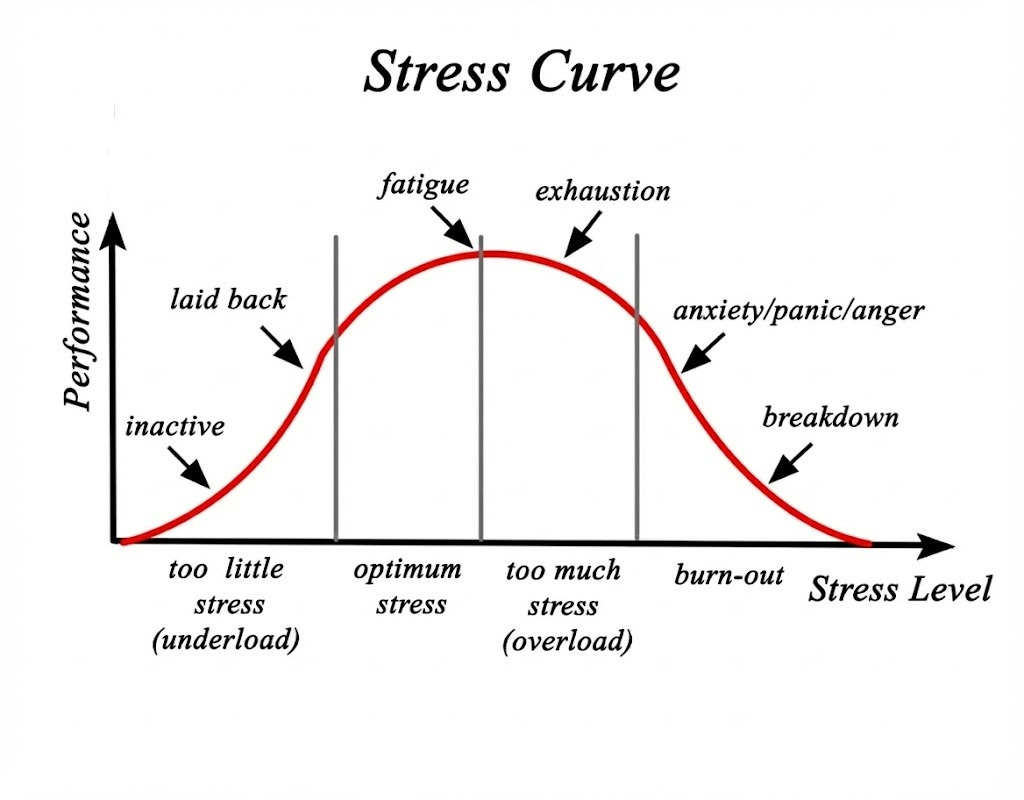
In behavioral medicine, this is called Allostatic Load. It is the wear and tear on the body that accumulates when you are exposed to chronic stress without recovery. When your allostatic load is high, your prefrontal cortex—the CEO of your brain—goes offline. You become reactive, emotional, and risk-averse.
You literally cannot afford to be unhealthy.
Research shows that 95% of your serotonin—the chemical responsible for your mood and focus—is produced in your stomach, not your head.
If you’re fueling your body with airport food, a preflight Old Fashion, and processed sugar, you aren’t just unhealthy. You are emotionally compromised. You are trying to lead complex organizations while your biology is fighting a civil war.
Or consider your sleep.
The “I’ll sleep when I’m dead” mantra is the most expensive advice in corporate history. And believe me, as a father of two boys under three years old—I am fully bought into the importance of maximizing every minute of rest.
Your brain has a cleaning cycle. Deep sleep is the only time your brain flushes out the toxins that accumulate during the day. If you aren’t sleeping, you aren’t cleaning. You are bringing yesterday’s brain fog into today’s strategy session.
For those flying 300,000 miles a year, you are often prioritizing a SkyMiles status over your health—and by extension, doing so at the expense of your family.
The executives I work with who sustain high performance over decades don’t just “try to be healthy.” They track their health data with the same rigor they track their revenue—often with an Oura ring or Whoop band.
Perhaps this is your calling to direct some of your obsessive disposition toward executive dominance inward on your own body and health.
The highest performing leaders that I work with use supplements to fix nutrient gaps. They lift weights to regulate hormones. They understand that a healthy diet is an anti-anxiety strategy.
But we have to ask the harder question—what good is securing a $500k+ compensation package if you don’t have the health to enjoy it?
What good is “winning” the career game if you lose the ability to hike with your kids, enjoy a meal without indigestion, or sleep without chemical assistance?
Two quotes hit me like a ton of bricks on this topic.
First: “When your career gets the best of you—your family gets the rest of you.”
They get the leftover scraps of what remains after your job devours the chef’s cuts.
And second: “Every parent says they would DIE for their children as a noble act of sacrifice—but how many parents would choose to LIVE for their children?”
Both require commitment and discipline. But only one has a positive outcome.
This isn’t just sentimental—it is strategic.
The market can smell exhaustion. It can see inflammation. It knows when you are desperate because you have nothing outside of the office.
When you walk into a room—or join a Zoom call—rested, nourished, and physically optimized, you project a biological signal of abundance. You signal that you have a life worth living.

And in the negotiation room, the person with the most control always wins.
