

The Subtraction Premium—Why Senior Leaders Need Less, Not More
On gratitude, subtraction, and the quiet power of choosing what to remove from your life to create space for what matters most.


Today is an important personal reflection for yours truly—but first, let me tell you what I’m seeing with top senior leaders in the market—and humbly add deeply intentional perspective.
There has been a shift in tone across my client base the last few months.
A shift I can’t ignore.
The anxiety hits different.
A more palpable tension.
It’s not the usual pre-negotiation nerves or the restlessness of being underpaid. Or the annoyance of corporate bureaucracy—or even the always stressful escalation of performance expectations in a tight market.
It’s deeper and heavier. It’s hitting you square in the jaw.
I’m working with leaders running nine-figure P&Ls who can’t sleep. Executives who’ve navigated three recessions and two IPOs—and are telling me, for the first time, that they feel stuck.
Others have nagging health concerns and family challenges they’ve been avoiding during the rut of the grind post pandemic.
Not just stuck in their careers.
Stuck in their lives.
The white collar tech market isn’t providing optimism. And it’s got a compounding effect.
The weight of an economy that can’t decide if it’s recovering or collapsing.
The geopolitical tension that makes every headline feel like a countdown. AI threatening to reorganize your entire industry before you finish reading about it.
And that’s just the macro.
Zoom in and it gets heavier.
Aging parents who need more from you.
Kids navigating a school system that feels like it’s failing them.
A spouse you barely see because you’re both in the trenches battling to combat endless rising costs of living.
A body that’s trying to tell you something you don’t have time to hear.
And through all of it, you’re expected to lead with poise, negotiate with precision, and show up like nothing is wrong.
And here I am, telling you to share your cards more strategically to maximize your earnings and leverage—which some misinterpret as hiding your true self, being disingenuous, or manipulative.
I get it. I really do.
Because here’s one thing I’ve learned after 15 years and tens of thousands of conversations with leaders: most of what we focus on could be categorized as “champagne problems.”
They are great problems to have.
We discuss negotiating between two seven-figure offers, not choosing between rent or groceries or gas.
We debate whether to take the CEO seat or stay as president, not whether you’ll be employed next month.
We talk leverage—not navigating a child with special needs or caring for a parent in hospice.
But champagne problems still weigh something.
And when you stack them on top of everything else—the real stuff, the human stuff—that weight can metastasize in something unrecognizable and ugly.
So today I’m not writing about negotiation tactics or comp architecture.
Nothing fantastical or seemingly out of reach.
Today I need to go somewhere more important.
Less
We are not dissimilar you and I. And your boss, competitor, or that investor are not all that dissimilar either.
We all have personal motivations and drivers—and we all face the short end of the stick from time to time. Frank Sinatra simply bellows, That’s Life.
I’ve noticed that the people who best navigate all life throws at them and still seem to have their feet under them appear to have a different point of view.
A sort of effortless poise that’s tricky to place your finger on. A collective confidence that I aspire toward. And it’s not luck or that weird hyper optimistic personality that is more annoying than motivational.
And they don’t have some secret to life.
No, they don’t do more. They don’t have more. They don’t know more.
They do less.
They stop trying to optimize every variable and start asking a harder question—one that most people are often terrified to sit with. Especially in a society that idolizes keeping up with the Joneses.
What would your life look like with less?
Less scrolling. Less performing. Less saying yes to things that don’t compound in the direction you actually want to go. Less carrying weight that was never yours to carry.
Not necessarily less work. Less noise.
Less work saying yes to things that compound in the wrong direction.
I call this The Subtraction Premium.
Can you automate it? Can you delegate it? Can you delete it?
Every framework in the business world is additive.
Add a skill. Add a credential. Add a board seat. Add another zero to the comp package.
I recognize the hypocrisy in me of all people writing that. I’m the guy you call to prioritize and accomplish all those things—and am guilty of going overtly “try-hard” to perhaps overcompensate for past sins.
The entire system is designed to make you believe that the next addition is the one that finally makes you feel like you’ve arrived.
But the leaders I admire most—the ones who actually enjoy the lives they’ve built—got there by removing things. Not adding them.
Maybe you feel this way too.
They remove the toxic board seat that eats their weekends.
They remove the “necessary evil” of platforms that tax their nervous system.
They remove saying yes to every introduction, every favor, every ask that comes dressed as opportunity.
While some express boredom in the early weeks following their scale back efforts—as I check in over time, anxiety doesn’t just decrease—clarity compounds.
You ever hear from folks that say, “I don’t think I could ever fully retire and just fish all the time, it would drive me nuts…?”
I’m not suggesting an extreme elimination diet here—although minimalism is a helluva liberating drug. I’m suggesting measured cuts that you can sit with to bring your world into view—into the present.
Subtraction doesn’t just free up time.
It frees up the cognitive bandwidth your brain needs to make the decisions that matter most.
The ones about your family. Your health. Your next move. Your life.
Too often we spend our careers proving we can add value. But I reckon once you’ve climbed the ladder, the harder skill—the one that separates the executives who are successful from the ones who are successful and at peace—is knowing what to subtract.
Staying
The biggest subtraction I ever made wasn’t a platform or a board seat.
It was subtracting the belief that the world would be better without me in it.
I don’t talk about this often—not because I’m ashamed, but because the gravity of it doesn’t fit neatly into a newsletter about executive compensation.
But today it fits. Today it’s the whole point.
There was a version of me—mid-twenties, broke, homeless, sleeping in a skatepark in Roseville, California—who couldn’t see past the next hour.
A version who drank to disappear.
Who used substances—and fast flings—not to feel good but to feel less. Who convinced himself that the people around him would recover faster from his absence than from his presence.
I often contemplated suicide—hovering the safety on a firearm and standing on the sun bleached green railing of the Foresthill bridge.

But I’m still here.
That’s not a sentence I write for sympathy.
I write it because everything—everything—that I’ve built, every client I’ve served, every framework I’ve developed, every word of this newsletter, my wife, my boys, and our future—exists on the other side of a decision I almost didn’t make.
The decision to stay.
There was no dramatic turning point.
No rock bottom movie scene. Just a slow, stubborn, unglamorous choice to keep going. I will say, a timely flip on the radio to Tim McGraw’s “Let It Go” changed my decision one fateful afternoon—and now every time I hear it you can queue the waterworks.
Then I kept choosing it again the next day. And the one after that.
Then I met Mary.
She came from circumstances as brutal as mine—worse even—and had every statistical reason to accept a predetermined future.
But she refused. She had faith—the kind that rebuilds a life from the studs. She had agency and conviction about what her life would be, and she wasn’t afraid to ask for it.
And she had it at twenty years old. Good grief.
She showed me that the story I’d been telling myself—that my future was already written—was a lie.
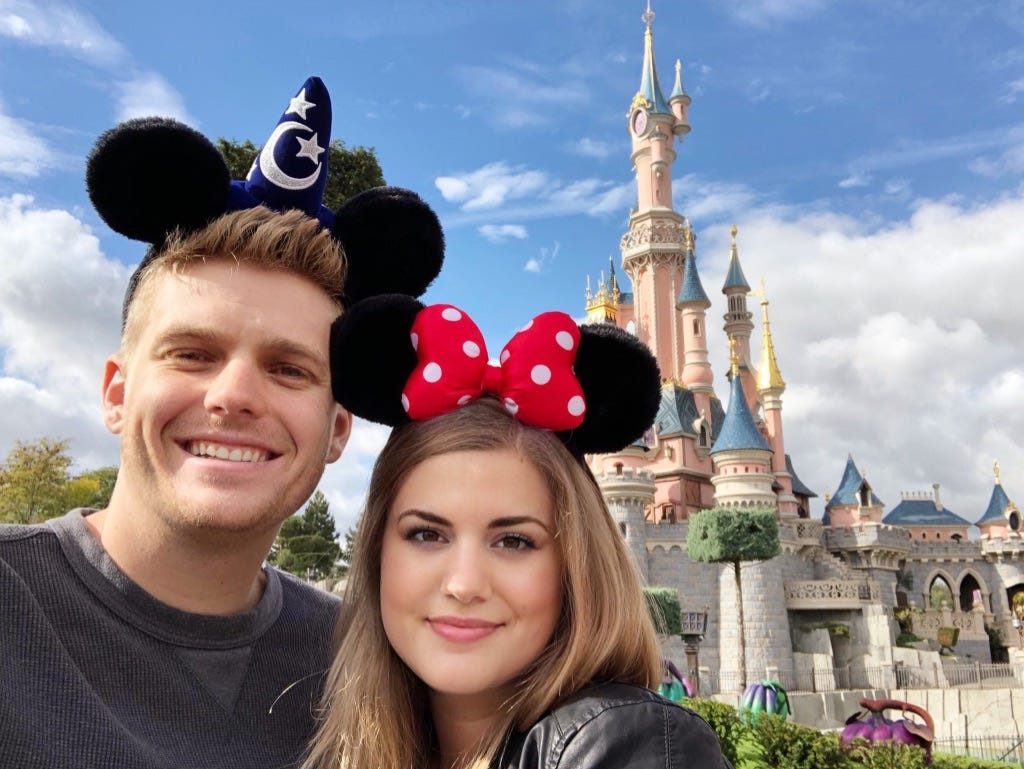
I’ll write more about this in my upcoming book. But the short version is: Mary showed me I had the agency to save myself.
That changed everything.
On January 1st, 2022, I made another subtraction as Mary and I got serious about having children. I stopped drinking entirely.
Raising children forces you to relive past trauma—but in experiencing your babies grow—the experience matures and heals your trauma. You didn’t deserve that pain, you were just a kid.
I never want my children to experience how substance abuse and domestic violence will slowly rip a family apart.
As I write this, I’m over 1,500 days sober.
However, I didn’t get sober because I had some profound revelation.
I got sober because I finally understood that alcohol was compounding in the wrong direction. Every drink borrows clarity from tomorrow. The interest rate is brutal.
Sisyphus had better odds.
My faith deepened in this season.
I started to see the evidence of something deliberate in my life. Too many close calls. Too many doors that opened when every logical outcome pointed to a dead end. At some point, coincidence stops being a satisfying explanation.
Sobriety didn’t add anything to my life. It subtracted the thing that was blocking everything good from getting in.
And what rushed into that space—once I stopped filling it with noise and poison—was gratitude.
Not the motivational poster kind. Not the “write three things in your journal” kind. Just the peace of knowing how a few key decisions and my present reality would be an unattainable dream otherwise.
The kind where you’re sitting on a porch in Montana with your beautiful partner and two boys and the spring air hits your face and you think—God, thank you—I almost didn’t get this.

Any of this.
That kind of gratitude simply needs space to exist.
And space only comes from subtraction.
Your Brain Can’t Hold Both
Mary told me something years ago that I didn’t believe at first.
I was spiraling—monologuing about how the weight of everything was getting to me as the CEO of Discover Podium.
How I wasn’t sure what to tell my staff who were drowning in the same anxiety I was feeling. You know, small businesses surviving COVID stuff.
She listened, then said two words.
Be grateful.
I pushed back. No way.
She didn’t flinch. “Your brain cannot process anxiety and gratitude at the same time. So be grateful.”
I fat-fingered a Google search to prove her wrong. Harvard agreed.
She was right. A comment I did not mutter vocally.
Here’s why this matters for you—not as a platitude, but as a biological fact.
When anxiety takes over, your brain shifts into threat mode.
The same system that kept your ancestors alive when a predator was circling now fires when you open your inbox, read a headline about tariffs, or sit across from a CEO who’s about to discuss your future.
Your heart rate spikes and your thinking narrows.
The part of your brain responsible for strategic decision-making—the thing you’ve spent your entire career sharpening—goes quiet at the moment you need it most.
You’ve felt this.
The moment a comp offer slides across the table and your mouth says “that sounds fair” before your brain catches up. The meeting where you had the perfect response rehearsed and forgot it the second the room got tense. The Sunday night dread that eats your evening before Monday even arrives.
That’s your chemistry.
But gratitude—real, deliberate gratitude—interrupts the loop.
It activates a different system entirely. One that lowers cortisol, restores clarity, and gives your prefrontal cortex back the oxygen it needs to function.
You can’t white-knuckle your way out of anxiety.
You can’t think your way past a threat response with more thinking.
You can’t simply be tougher and more disciplined—which is likely how you’ve overcome most other things that get in your way. What got you here, won’t get you there.
However, you can replace it.
Gratitude isn’t the absence of anxiety. It’s the antidote.
This is why subtraction matters beyond your calendar and your commitments.
When you subtract the noise—the doom scrolling, the performative obligations, the relationships that drain you, the LinkedIn humblebragging—you create space for gratitude to do its work.
And when gratitude is running the show instead of anxiety, you make better decisions.
You lead with more clarity. You show up for your family without the static in the back of your head.
You no longer have to do challenging things; you get to do challenging things.
For them.

If you think back on how you’ve gotten to where you are today, you can objectively say that in most cases you make great decisions.
If you’re reading this article today, you are already performing in the top percentile of people globally—at least according to what our society tends to value.
Trust yourself to continue—and that your champagne problems are a reason to celebrate.
Gratitude is not soft.
It’s the hardest reframe most leaders will ever attempt.
Because it requires you to stop focusing on additive performance long enough to feel something real.
When your clarity becomes abundant—your ability to negotiate for your life becomes second nature. You won’t even need to call me.
What Would Your Life Look Like With Less?
I ask my clients this question more than any other.
More than “what’s your target comp?” More than “what’s your walkaway number?”
Because the answer reveals everything.
About a decade ago, I worked with a couple in Los Angeles. Husband—a high-profile HBO executive, early fifties, making $1.2M a year. Wife—a CMO in Orange County, earning around $900K.
No children. Eight figures in the bank.
The husband was diagnosed with stage one cancer. His doctor warned that the stress of working would likely kill him—but he was three years short of full pension.
The wife, meanwhile, was laser-focused on landing a higher-paying CMO role. When I pressed on why, the answer was simple—she wanted to finally out-earn her husband. Perhaps to give him permission to stop. But neither of them needed to work. They didn’t even need to live in Los Angeles.
What do you think their life would look like with less?
When she asked what she should do, I told them to take four weeks of PTO in Hawaii and leave their phones behind.
They chose to retire on the flight home.
They’re both still enjoying themselves today.
Most executives only consider what less looks like near the twilight of their career.
They’ve optimized relentlessly—for title, for comp, for prestige, for the next rung—but too many have never stopped to ask whether the ladder is leaning against the right wall.
And in chasing their maximum potential—they often forget to live in the moment. Or worse—they live for someone else’s moment.
Money decreases in value as we age. It’s taxed. Inflated. Stripped away.
Yet time increases in value as we age. It grows scarce.
We’re quick to lose every negotiation by trading time for money.
So, I ask: what would your life look like with less?
When I ask, the room usually goes quiet. Not because you don’t know the answer. Because you do—and you know you can do something about it.
It’s some combination of less.
Less obligation. Less performing. Less carrying the expectations of people who wouldn’t carry yours.
Sometimes the answer is cutting a board seat you’ve been dreading for two years or quitting a toxic, unethical, or misaligned company.
Sometimes it’s leaving a city you hate living in.
Sometimes it’s ending a relationship you’ve outgrown but maintain out of guilt.
Sometimes it’s tossing the device in your pocket that steals more than it gives.
Sometimes it’s deleting all social media accounts and becoming a digital ghost.
Sometimes it’s removing addictive highly processed food, seed oils, sugar, alcohol, and substances.
The answers are always specific. And they’re always obvious—in hindsight.
This week, consider a strategic audit of your life.
Write down three things you’re carrying that aren’t compounding in the direction you want to go.
Be honest. Nobody sees this list but you.
Then ask yourself—for each one—can I automate it, delegate it, or delete it?
You don’t have to act on it today. Just name it. Because the act of naming it—of pulling it out of the background static and putting it on paper—is itself a subtraction.
You’re taking something that’s been quietly taxing your nervous system and forcing it into the light where it loses half its power.
And then write down three things you’re grateful for.
Not the things you think you should be grateful for. The real ones. The ones that hit you in the chest when you’re not performing for anyone.
Your kid’s laugh at dinner. Waking up healthy. A partner who sees through your armor and loves what’s underneath. The career you’ve built—even when it’s heavy—because you built it. That’s yours.
Hold both lists.
The things to subtract. The things to protect.
That’s your compass. Not your comp band, not your title, not the market—that list is your compass.
There's a rule in aviation—if a plane is off by a single degree at takeoff, it drifts one mile for every sixty flown.
The pilot doesn't feel the error. The passengers don't feel the error.
But after enough distance, the plane lands somewhere it was never meant to be.
This is why the audit matters.
You're not looking for catastrophic misalignment. You're looking for the one-degree drift—the thing that feels small today but is quietly compounding you toward a destination you never chose.
Consider:
A 12 ounce soda a day is 10lbs of extra calories a year.
30 minutes of lost sleep every night is a month of sleep debt a year.
Sitting an hour longer every day increases cardiovascular risk 14%.
I spent the first half of my life adding—clawing, building, chasing, numbing, performing. I spent the second half learning that the things I subtracted gave me more than anything I ever earned.
Sobriety gave me more than any deal I’ve closed. Faith gave me more than any framework I’ve named. My family gives me more before 7 AM than my career gives me all year.

Trust me.
And gratitude—the simple, stubborn, daily practice of noticing what’s already here—gave me back a life I almost threw away.
You don’t need more.
You might just need less.
Ready to discuss your career? Book a strategy session.
Stay fearless, friends.
Just wanted to send a note of thanks - this year I have been working on gratitude, sharing my learnings from others on how that works in our minds and bodies.
Appreciate your vulnerabilities in your writing and have shared with many of my colleagues and friends. So funning i was going to suggest a book, then you shared you are in the middle of one.
Grateful
Great post my friend ! I would add that less is not only about daily things that you do but daily things that you want to have too. Do you really need this new suit / car / boat ?