

Why Corporate Culture Rewards Sociopathic Leadership (And What to Do About It)
Why we mistake dissociation for focus, abuse for intensity, and untreated trauma for greatness—and how leaders can demand better.


From 2000 to 2003, basketball wasn’t a hobby for me.
It was oxygen.
I was the kid wearing And1s, obsessed with Allen Iverson’s crossover, trying to carry that grit onto the asphalt.
I spent hundreds of hours on my PS2 mastering NBA Street Vol. 2, and thousands more in my backyard, jumping until my legs burned, desperate to add a single inch to my vertical.
It didn’t happen, but I digress.

Basketball was my escape from the reality of childhood trauma—and I was impressionable and desperate for a male idol.
At the center of my universe was Kobe Bryant.
I was a diehard Lakers fan living deep in Northern California—hostile territory.
When Robert Horry hit that dagger three in Game 4 of the 2002 Western Conference Finals, I walked into class the next day in my Kobe jersey, ready for war. I mocked my classmates. I collected Kobe rookie cards (I still have them).
Yeah I’m not proud of it.
I didn’t just watch Kobe. I loved Kobe.
Then came the summer of 2003.
Eagle, Colorado.
I watched the trial updates religiously. I remember the knot in my stomach. I prayed for his innocence because if he wasn’t innocent, then the model I had built my life around was tainted.
Then the details came out. The admitted adultery. The settlement. The diamond ring apology press conference.
What really happened?
I guess we can only speculate—though the bruising suggests otherwise. Part of me wonders if we’d have a different outcome if this happened during the #metoo era.
I still get sick thinking about it.
Feigning ignorance is no excuse for alleged rape.
And let’s say you are innocent—a $4 million dollar apology ring doesn’t change the fact that you barely made it two years into marriage without cheating on your wife—though you openly admitted to other indiscretions too.
And then, I watched the greatest magic trick in sports history.

Whether Kobe used this as a survival mechanism or a performance hack is up for debate—but the way Corporate America adopted it is undeniably toxic
Imagine that.
Kobe openly admitted that he created “The Black Mamba” alter ego to handle the backlash of the sexual assault case.
He killed the accused rapist and replaced him with a superhero.
And everyone simply turned the other cheek—as we often will.
And it worked.
The Corporate Hall Pass
Corporate America didn’t just watch the magic trick; they copied it.
Walk into a high-growth startup or a sales bullpen and you’ll inevitably hear “Mamba Mentality” quoted as scripture or intense Kobe posters used in the backdrop for a Zoom call.
Why?
Because we love winners more than we value character.
But more importantly, we idolize the “ruthless competitor” because it gives us permission to be sociopathic in the pursuit of revenue. The water is full of sharks, and eventually, everyone bleeds.
What’s more frustrating is that the behavior is celebrated.
Perhaps I’m jaded from my recent work helping several executives navigate hostile PE takeovers and vengeful nepotism. I’ve watched good leaders get pushed around, chewed up, and spat out.
It seems this toxic 'it’s not personal, it’s business' mentality is rampant.
And this so-called Mamba Mentality keeps resurfacing.
It is the ultimate Hall Pass.
If you yell at your team, you aren’t abusive; you’re “intense.”
If you neglect your family to close a deal, you aren’t an absentee parent; you’re “dedicated.”
If you bulldoze your peers, you aren’t a jerk; you have a “killer instinct.”
We look at the rings, the points, and the “dominance,” and we decide that character flaws don’t matter as long as the stock price goes up.
If you’re a tyrant, don’t admit it—rebrand it.
In the boardroom, we call this the ‘Competence Immunity.’
If a sales VP is hitting 150% of their quota, HR looks the other way when they scream at an assistant. If a founder raises a Series B, the board ignores the massive turnover and burnout rates.
We have decided that ‘High Performance’ is a solvent that washes away toxic behavior.
But this is a short-term trick.
You might respect the rings, and you might respect the revenue.
But ask yourself: Would you want your son to treat his spouse the way your top performer treats their team? Would you want your daughter to accept ‘greatness’ as an excuse for betrayal?
If the answer is no, then why do we accept it on our cap tables?
The Biology of “Fake” Strength
We need to name this behavior accurately. In psychology, this isn’t called “excellence.”
It is called Dissociation.
The human brain has two distinct modes of operation:
The Task Positive Network (TPN): Used for problem-solving and execution.
The Default Mode Network (DMN): Used for empathy, social connection, and reflection.
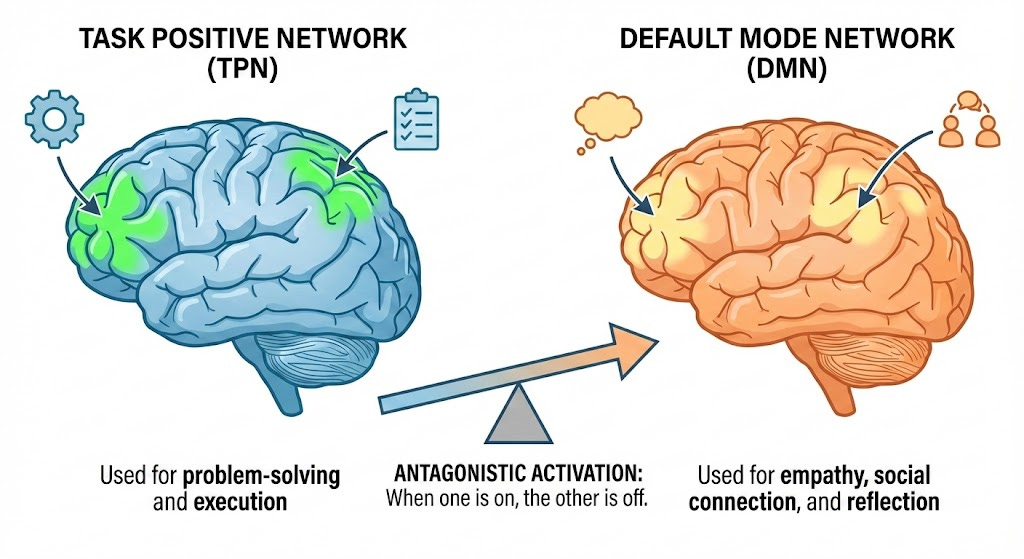
Neuroscience shows these two networks are antagonistic—when one is on, the other is off. You cannot be hyper-fixated on a task and deeply empathetic at the same time.
The strongest senior leaders will switch back and forth between networks rapidly. While we can’t do both simultaneously, the “Mamba” error is the refusal to switch back, effectively atrophying the empathy muscle.
Kobe created the persona to survive the trauma of his own making. He needed to separate from “Kobe the husband/defendant” to become “Mamba the assassin.”
I fear many of our peers in the C-Suite have done the same.
When executives adopt this persona, they aren’t channeling greatness. They are choosing to numb their humanity.
They are turning off the part of their brain responsible for guilt so they can drive their teams into the ground—and profits through the roof—without feeling the impact.
And we wonder why Millenials, Gen Z, and Alpha are quick to do anything they can to escape these very public—but seldom acknowledged—corporate smoke and mirrors.
The “Boos Don’t Block Dunks” Fallacy
The most dangerous tool in this dissociation toolkit is a single, catchy phrase: “Boos don’t block dunks.”
I have heard this—or a variation—of this quote more times from executive leaders than I’d care to count. On the surface, it sounds stoic. It sounds like “focus.”
But in reality, it is a psychological shield.
It frames Accountability as Opposition.
It convinces a leader that valid criticism regarding culture, ethics, or burnout isn’t “feedback”—it’s just “noise” from people who want to see you fail.
It allows them to act like tyrants because it categorizes all dissent as “hating.”
Guess we see this in politics as well—but with global implications.
This is a failure of intelligence.
In any other context, if the market screams that your strategy is failing, you listen.
You pivot. You fix the product.
But when the “Mamba” leader hears the market (their employees, their spouses, their children) screaming that something is broken, they simply turn up the volume on their own ego.
“Boos” from your team mean your culture is eroding.
“Boos” from your family mean your relationships are in default.
When you adopt the stance that “lions don’t lose sleep over the opinions of sheep,” you sever your feedback loops. You are flying the plane with the instrument panel turned off.
To be honest, I’m guilty of this mentality as well—especially recently when getting backlash that I think is honestly beneath me.
But hey, I can be an asshole too.
You might hit your Q4 numbers. But eventually, you will crash. And unlike Kobe, you likely won’t have the PR machine to spin the wreckage into a legacy.
Let’s be clear: The discipline is real. The 4:00 AM wake-up calls, the thousands of made jumpers, the obsessive study of game film—that is a feature, not a bug.
We should all aspire to that level of mastery in our craft—and I suspect that is exactly what these leaders choose to concentrate on. That is admirable.
But we must stop conflating Professional Discipline with Personal Immunity.
Being the hardest worker in the room buys you success. It does not buy you a pass on basic human decency.
We too often accept a false social contract that says if your output is high enough, your character requirements are lowered.
That isn’t ‘focus.’
That is a transaction. And it’s a bad one.
I’m not saying you’re a jerk if you love Mamba Mentality—I think you aspire for habit, discipline, and growth—rather, I’m saying that I can’t unknow what I know about where it came from—and I can’t look the other way.
Integrating The Whole Human Asset
So, where do we go from here?
Do we abandon excellence? Do we stop trying to win?
No.
But we must stop confusing Dissociation with Leadership.
Real power isn’t about creating an alter ego to escape accountability. It is about Integration. It is about managing the whole human asset—shadow and all.
We have to move from the “Mamba” script (Script A) to the “Integrated” script (Script B).
Script A: The “Mamba” Leader (Dissociated)
The Context: A high-performer says they are burning out and the timeline is unrealistic.
The Response: “We don’t complain here. If you can’t handle the pressure, maybe this isn’t the seat for you. We need killers.”
The Outcome: You trigger their biological threat response. They shut down, work from fear, and eventually quit, taking their institutional knowledge with them. You have burned the asset to hit a short-term metric.
Script B: The Integrated Leader (Connected)
The Context: Same scenario.
The Response: “I hear you. The timeline is aggressive because the market demand is real. But burning you out isn’t my intention. Let’s look at the workflow—what can we pause or delegate so you can hit this target without breaking the engine?”
The Outcome: You validate their biology. You lower their Cortisol. You retain the talent and solve the structural problem.
Script A feels stronger in the moment. It gives you a rush of dominance.
Script B is actually stronger. It creates sustainable leverage.
We don't need to kill the Mamba to save the Man. We need to harness the Mamba for the Man.
You must control it.
Keep the grit. Keep the obsession to detail. Keep the refusal to accept mediocrity. But decouple it from the idea that you must be a lone wolf or a tyrant to wield it.
True greatness isn’t achieving perfection at the cost of your humanity. True greatness is achieving perfection because your humanity is intact.
You can be a killer on the court and a faithful partner at home. You can be a ruthless competitor in the market and a supportive leader in the office.
The lie isn’t the work ethic.
The lie is that you have to sell your soul to maintain it.
Stop Worshipping the Mask
I still have the cards. I still remember the feeling of those And1s on the pavement. But I can no longer separate the player from the person.
“Mamba Mentality” isn’t a leadership philosophy.
It is a trauma response branded by Nike.

It is the sound of a man running away from himself.
As a father of two boys who will soon be men amongst us—I can’t tolerate this. I must lead my family and stand up—not hide behind the fact that most people won’t notice when your integrity slips.
Every time an executive quotes Kobe—or Jobs—or idolizes the companies eroding our humanity—to justify burning out their team or acting like a tyrant, they aren’t channeling greatness.
They’re just proving that, like 13-year-old me, they prefer the beautiful lie to the ugly truth.
Winning a championship (or a Q4 target) means nothing if you have to dehumanize yourself and our greater community to get there.
Stop worshipping the alter ego. Start demanding the whole human.
Ready to discuss your career? Book a strategy session.
Stay fearless, friends.
Not sure how you found your way to my inbox … but I’m glad you did. Great piece.
"It convinces a leader that valid criticism regarding culture, ethics, or burnout isn’t “feedback”—it’s just “noise” from people who want to see you fail.
It allows them to act like tyrants because it categorizes all dissent as “hating.”
THIS PART. I think performance has been an excuse for lack of empathy and lack of thoughtful people leadership for a long time and still shows up.