

How AI Tools Help (and Hurt) Your Executive Job Search
ChatGPT is statistically engineered to make you average—and average is death at the executive level. Why generic AI flattens your positioning, and how to use it as a partner, not a proxy.


Today's expert is Justin Parnell, the AI architect behind our free LinkedIn Profile Reviews and Interview Prep Reports. He runs Justin-GPT, where he consults with influencers, solopreneurs and executives on all things AI strategy, automation and agent building.

Hey everyone, Justin Parnell here.
I’ve spent years building AI solutions and diving into how these models work under the hood. I’ve learned a few tricks that will save your career from drowning in a sea of sameness as you use AI.
Most people use AI completely wrong for their executive job search.
Unfortunately, it’s not cutting-edge to have ChatGPT write your resume or prep your interview answers. The truth is, you're statistically programming yourself for mediocrity. And I'm going to show you exactly why — with the actual math and neuroscience behind it.
While AI tools are undeniably powerful, relying too heavily on base models like Chat GPT, Claude and Gemini for your job search will ensure that you'll never stand out from the pack.
Readers of Execs and the City don’t aim for middle ground—they shoot for the top 1%.
But here's the problem.
AI, by its very design and training, is designed for finding the "average."

Let me break down exactly why that happens, and more importantly, what you can do about it.
Understand What Happens Under the Hood
To grasp why AI is sabotaging your differentiation, you need to understand — at least conceptually — how Large Language Models (LLMs) operate.
Don’t worry, we're not going for a PhD. The basics matter more than you think.
Most modern LLMs you're using — whether it's GPT from OpenAI or Claude from Anthropic — are built on something called Transformer architecture.
Here's what that means for your job search.
Why Context Matters (And How AI Gets It Wrong)
Think about how you read a dense board report.
You don't give equal weight to every word — you focus on crucial sentences, keywords, and phrases that convey core meaning.
The Transformer's "Attention Mechanism" tries to do something similar. It weighs the importance of different parts of input text to understand context and relationships between words.
They use something called "Self-Attention," which helps the model understand how different words relate to one another.
This gives modern LLMs a richer grasp of grammar and meaning than older models.
It's why these models can handle long-range dependencies and process information more effectively.
But here's where it gets interesting for you...
What Generative Pre-trained Transformers Do
The name "GPT" tells you everything you need to know about the limitation.
It stands for "Generative Pre-trained Transformer."
Generative: Its primary function is to create text, not analyze or classify it.
Pre-trained: This is the killer — these models undergo massive initial learning where they analyze enormous datasets scraped from the internet before they ever interact with you.
The "learning" happens through backpropagation and gradient descent.
Now bear with me a moment.
Think of it like a golfer improving their swing.
You first take a shot (the model makes a prediction).
Then you see where the ball lands relative to the hole (the model calculates error).
Then you adjust your grip, power, and stance (the model adjusts millions or billions of internal parameters) to reduce that error next time.
Then you try again, predicting a closer outcome.

At its absolute core, what an LLM does is Next Token Prediction.
It looks at the sequence of words it's seen and calculates the probability of what comes next.
Then it picks the most likely option, adds it, and repeats.
Token by token.
It's sophisticated statistical pattern matching – not "understanding" in any human sense.
Why AI is Biased Toward Mediocrity
Now we hit the core issue that's killing executive job searches.
The pre-training phase relies on the vast ocean of text available online.
When AI processes this information, it transforms words and concepts into numerical representations — vectors or embeddings. Words with similar meanings cluster together in high-dimensional mathematical space.
In layman’s terms…
Picture the distribution of all that online text data:
Resumes
Advice columns
Business articles
LinkedIn profiles
Cover letter examples
What does the vast majority represent?
Common language. Average performance. Standard advice. Typical writing styles.
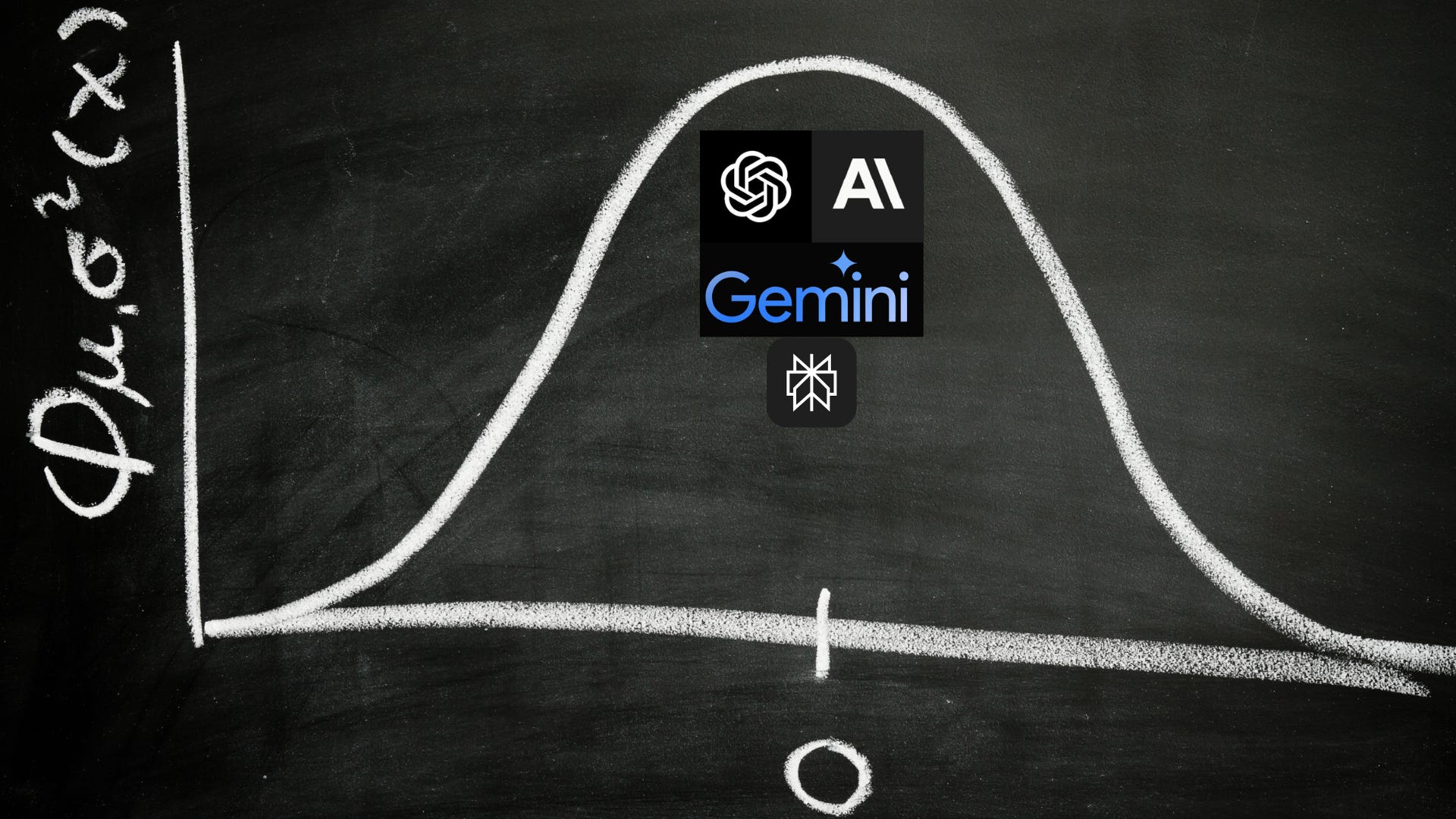
If you plot this data, it forms a bell curve.
The peak — where the highest density of data points lies — represents the average. This middle ground is where the LLM receives the most input and develops the strongest predictive capabilities.
But where does exceptional performance data live?
Groundbreaking leadership strategies, uniquely compelling executive resumes that defy formats, nuanced negotiation tactics that lead to extraordinary outcomes — this information is inherently scarce online.
The best intel exists in the thin tails of the curve, perhaps the top 10%, 5%, or in your case 1%.
The statistical implication is profound.
If you are in the 30th percentile of your career—GPT’s can help bring you to the 50th percentile. If you’re in the 90th percentile of leaders in your career—it’s likely that a generic GPT will make you look worse.
Because LLMs are predominantly trained on "average" data, they are statistically biased toward producing "average" outputs.
This isn't a bug — it's a fundamental consequence of their training process and data distribution.
You must have deep knowledge and subject matter expertise in order to realign how the AI assigns meaning to words and subjects in order to generate outputs away from the mean.
Historically that information has been gated in a cost prohibitive way.
For example, Jacob guided two c-suite executives into new roles in May.
One had over 40 hours of his direct support — and the other needed half as long with direct one on one time.
Those clients paid fees north of $50k and $100k respectively for landing 7 figure plus deals with significantly lifted performance kickers.
The deep insight needed to achieve those outcomes was gated behind serious retainers and Jacob’s time.
That’s why Jacob and I have to work together to extract the best of his experience to guide the LLM to offer leading—not mediocre insight.
Specialty training, not simply pre-training.
This is done through a process called RLHF. It’s how we make very valuable and expensive specialty knowledge accessible to everyone. More on that later.
Why Averages Destroy Your Executive Position
Understanding this tendency toward the mean is critical because your job search objective is the polar opposite—differentiation.
You're not trying to meet basic requirements.
You're demonstrating exceptional qualities, strategic vision, and leadership impact that places you well above average candidates.
When you rely too heavily on AI that's statistically predisposed to generate average outputs, you risk several career-killing outcomes.
Generic Application Materials
Your AI-produced resumes and cover letters might be grammatically perfect and well-structured, but they'll lack:
Unique narrative arc
Specific quantifiable achievements
Compelling value propositions
The elements that capture discerning hiring committees' attention
Any meaningful differentiation
Uninspired Interview Responses
Using AI for interview prep produces safe, standard responses lacking:
Strategic depth
Personal conviction
Authentic leadership presence
The executive gravitas expected at senior levels
Missing Your Differentiators
Most concerningly, AI fails to identify or articulate the truly unique, non-standard aspects of your experience — the exact things that make you exceptional — because those aspects don't fit common patterns in its training data.
The primary danger lies in over-reliance.
Using AI as a substitute for genuine self-reflection, strategic thinking, and personalized communication. If your materials sound AI-generated, you sound like everyone else using these tools.
This homogenization is the exact opposite of what executive candidates need.
There is perhaps no better example than the wannabe executives playing dress up on LinkedIn and hiding behind soft AI generated “thought” leadership content.
A discerned eye like yours can see through the BS and appropriately rank and file these bad actors—so don’t fall victim by copying their losing strategy.

AI with RLHF
So should you abandon AI completely?
Absolutely not.
The key is understanding how to not rely on base models like ChatGPT, Gemini, Grok, and Claude on their own.
You need to infuse uncommon insights into the models to train them to apply their technology to the uncommon insights that set you apart.
I've worked with Jacob to do exactly this.
We've spent months training and investing capital into developing AI models aligned to Jacob's uncommon, proprietary, and private methodologies. Our AI Agents provide differentiated output away from the mean outputs of standard LLMs.
We've received this exact feedback from clients: "This is much different than what I usually get from using ChatGPT."
That’s the key.
And you must do this too in order to stand out.
The secret is in the alignment work necessary to get you top 1% differentiated outcomes.
By investing in model training, RLHF (Reinforcement Learning from Human Feedback), and alignment assessments, we've created a custom experience leveraging transformer model power to group Jacob's insights into a neural network.
This aligns gradient descent and back propagates down to outputs aligned with what Jacob would likely advise himself.
How Our Differentiated AI Agents Work
Our career AI Agents for; LinkedIn Reviews, Interview Prep Reports and Jacob’s new digital twin for paid subscribers, don't just regurgitate average advice.
Instead they:
Draw from proprietary methodologies not found in public training data
Apply uncommon insights specific to executive-level positioning
Generate outputs statistically different from base model responses
Combine AI technology power with human expertise that sits in the top percentiles
You can try each for free and experience how Jacob's uncommon and proprietary insights combined with AI technology create genuinely differentiated results.
How to Navigate AI in Your Executive Journey
AI and Large Language Models are remarkable technological achievements offering capabilities that streamline tasks and spark creativity.
Here's how to ensure your job search strategy reflects that exceptionalism:
Your AI Should be a Partner, Not a Proxy
Use it to enhance your own thinking and refine your work, but never to outsource the core responsibilities of leadership. The moment you ask an AI to generate the foundational strategy, you have abdicated a key part of your role.
Brainstorming initial ideas
Polishing grammar and structure
Checking for completeness
NOT for core strategic thinking or personal branding
Example: Preparing a Board Presentation on Market Expansion
An executive is tasked with presenting a 3-year plan to enter a new international market.
Bad Use (Replacement): The executive uses a generic prompt, asking the AI to do the core strategic work.
Prompt to AI:
"Create a 3-year strategic plan for my manufacturing company to enter the European market."
Result: The AI will produce a generic, textbook plan lacking any specific knowledge of the company's unique strengths, culture, risk tolerance, or competitive landscape. It will mention common steps like "conduct market research," "establish legal entities," and "develop a marketing strategy," but it will have zero authentic strategic value. It's a hollow shell.
Good Use (Augmentation): The executive develops the core strategy and uses AI as a thinking partner to strengthen it.
Step 1: Brainstorming Risks (Human develops strategy, AI checks blind spots)
Prompt to AI:
"I'm developing a plan to enter the German manufacturing market. My core strategy focuses on acquiring a local distributor. Based on this, what are the top 5 potential operational and cultural risks I should be prepared to address?"
Step 2: Polishing Communication (Human writes message, AI refines it)
Prompt to AI:
"Here is the executive summary of my plan. Please review it for clarity, conciseness, and executive presence. Make it more impactful without changing the core message: [Inserts their drafted paragraph]."
Step 3: Checking for Completeness (Human finalizes content, AI audits it)
Prompt to AI:
"My board presentation on European expansion covers market analysis, acquisition strategy, logistics, and financial projections. What key areas might I be missing that a discerning board member would likely ask about?"
2. Prioritize Human Alignment Tactics
The most valuable parts of executive communication are precisely the things an AI cannot replicate because it has no life experience. Your history, your hard-won beliefs, and your unique perspective are your brand. These elements build trust and inspire action in a way that perfectly structured but soulless text never will.
This includes:
Strategic thinking
Personal branding
Authentic storytelling
Genuine networking
Your unique value proposition
Example: Crafting a Personal Bio for a Conference
An executive needs to write a short bio for an industry event. Her unique value is her reputation for turning around failing projects through hands-on, empathetic leadership.
The Human In the Loop (Anecdotal Alignment): The executive first reflects on her career and identifies a defining moment. She decides her story of salvaging "Project Horizon" is the best representation of her brand. She writes down the raw, authentic story from her perspective:
"My proudest moment came from our biggest failure. We launched Project Horizon and the initial user feedback was a disaster. Instead of hiding behind spreadsheets, I spent two weeks on the road meeting with our most frustrated customers, just listening. That experience taught me more than my MBA ever did and led to the critical pivot that ultimately made the product a market leader. I believe that true leaders find the most valuable data in the field, not in a dashboard."
AI Augmentation (Packaging the Human Alignment): Now, she can use AI to professionally package this authentic narrative.
Prompt to AI:
"Using the story and philosophy above, write a 150-word professional bio. The tone should be confident and inspiring, but also humble. Retain the core message about learning from failure and customer-centricity."
Result: The AI will structure her authentic story into a polished bio, but the heart of the message, the personal conviction and unique value proposition, comes directly from her experience which has aligned the AI to generate a better output.
3. Leverage Specialized AI Solutions
Not all AI is created equal. Generic chatbots are trained on the vast, messy, and largely average public internet. For high-stakes executive tasks, seek out specialized AI tools that have been trained on curated, high-quality data and are designed to produce more nuanced and sophisticated outputs.
Seek AI tools trained on exceptional data
Use systems with human expertise integration
Prioritize differentiated outputs over convenience
Example: Announcing a Difficult Company Restructuring
A CEO must draft a company-wide email announcing layoffs. The goal is to be clear, direct, and empathetic, preserving the trust of the remaining employees.
Using a Generic, Convenient Tool (e.g., a standard LLM chat):
Prompt to AI:
"Write a professional email to all employees announcing layoffs due to restructuring."
Result: The AI will produce a legally safe but cold and formulaic email using standard corporate jargon like "right-sizing the organization," "optimizing for future growth," and "leveraging synergies." While grammatically correct, the output feels impersonal and can erode trust precisely when it's needed most. It's a convenient but undifferentiated, low-quality solution.
Using a Specialized AI Solution: The CEO uses a hypothetical premium tool called "Jacob's Digital Twin," which states it is "trained on a private dataset of vetted communications from Fortune 500 leaders and crisis management case studies."
Prompt to "Jacob's Digital Twin":
"Draft an email announcing we are parting ways with 15% of our staff to restructure for long-term stability. The tone must be direct, deeply empathetic, and focused on our commitment to both our departing and remaining colleagues."
Result: This specialized tool, drawing from its exceptional data, produces a more nuanced draft. It might:
Integrate Human Expertise: It could prompt back: "To enhance authenticity, please state the two main principles guiding your support for departing employees."
Suggest Differentiated Output: The language it uses is more human. Instead of "right-sizing," it might suggest, "This is a difficult but necessary decision to ensure our company's long-term health, and it means we must say goodbye to talented colleagues." It may also suggest a structure that leads with a direct acknowledgment of the human impact before explaining the business rationale, a best practice from its crisis communications data. The output is less convenient (it might require more input) but is strategically and emotionally superior.
See you in the matrix.

The tools and services I have developed with Jacob including our LinkedIn Profile Audits and Interview Prep Reports, are trained on Jacob’s deep and uncommon insights that have resulted in consistent client wins and over $1 Billion in negotiated outcomes.
Getting to the top 1% of results requires training systems and services, like ours, on proprietary and private data that recontextualizes the AIs training and assigns new meanings to the underlying words and phrases it will supply in its outputs.
This goes beyond simply prompt engineering and into concepts of network alignment, reinforcement learning and interpretability of training data.
You can give our tools a try for free and see sample outputs to understand how they are different from standard answers you will get from ChatGPT, Claude or Gemini.
If you're an executive looking for guidance on leveraging AI strategically — using its power effectively without falling into the mediocrity trap — that's precisely the consultation I provide at Justin GPT.
You can subscribe to my Substack or follow me on LinkedIn.
The bottom line: Understanding the mathematical and statistical reality of how AI works isn't just academic curiosity. It's the difference between blending into the middle of the pack and positioning yourself where you belong — at the top.
Ready to discuss your career? Book a strategy session.
Stay fearless, friends.
 | A guest post by
|