

The Room Was Won Before Anyone Sat Down
What we taught at PTTOW—and how to apply this for yourself.

Before we dive in: I'm running this negotiation and influence workshop live in San Francisco on July 14th. It's the same session I'm about to walk you through—part teaching, part live coaching, part AMA, where we apply these lessons to your specific scenario. Reply or comment and I'll send you the registration link first.
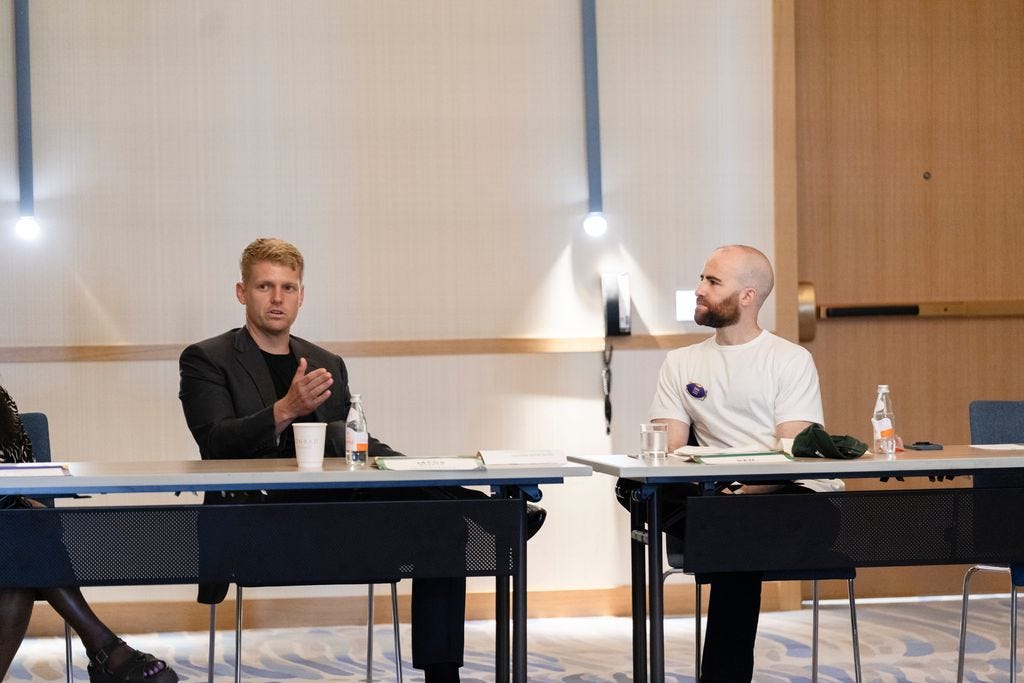
Two weeks ago I led a negotiation and influence workshop for a room full of senior leaders at the PTTOW Summit, held at the Conrad in Orlando.
My co-host Dan Robbins kicked off the session with one simple question—a question I’d invite you to answer for yourself right now.
Who has an important outcome you need support on in the next thirty days?
Every hand went up.
Keep it up if you have a repeatable way to influence that outcome in your favor—every time.
Almost every hand dropped.
That gap—between the outcomes every senior leader is responsible for closing and a repeatable way to close them consistently—is where influence stops being optional and becomes the dominant trait for success at the top.
Nobody gets in this room by accident.
And if you’re reading this publication, you’re likely running brands, building companies, and sitting at the top of your function.
You know how to do the work. The functional work.
But what gets you in the room and what keeps you there are two different challenges. This publication exists to make sure you have the skills and systems for the part that happens before your work ever gets evaluated.
The game changed and nobody told you
The corporate climb rewards being good at your job. Competence. Logic. A track record you can point to.
That’s what gets you in the room.
Aristotle would call this mastering Ethos and Logos.
Then—somewhere around VP—the game quietly changes.
The outcomes stop depending on whether you’re right and start depending on whether the right people were already on your side before the conversation began.
Network. Presence. Emotion.
Now the third leg of rhetorical control is the one that matters—Pathos. And the Carnegies and Cialdinis of the world have piled on decades of research showing exactly how it gets built: shared identity, likeability, reciprocity, trust, etc.
Nobody hands you that memo. It’s just expected.
So most leaders keep playing the only game they were ever rewarded for—be excellent, be prepared, let the work speak.
And the work does speak. It just doesn’t decide anything.
The people who stall out a level below where they should be are rarely the least capable in the building. They’re the ones still trying to win on merit in a game that stopped being scored that way years ago.
This has always bothered me.
And it probably bothers you too—though if you’re like the senior leaders in that room at PTTOW, you’re nodding along right now.
You negotiate for yourself five, maybe ten times in your entire career.
The organization across the table does it thousands of times a day.
You are an amateur walking into a room of professionals—and nobody warned you about that either.
So you show up the day of the conversation, ready to make your case, and you discover the case was mostly decided before you opened your mouth. Most leaders feel that and conclude it’s just how these things go.
Predetermined.
It isn’t. They just arrived three years too late.
Because influence doesn’t start when you sit down at the table.
It started three years ago.
I once represented a VP of Communications who moved from a major tech company to a Fortune 50 in the middle of total chaos. Our outcome?
Moving from $600K to $1.4M annually—with an additional $800K signing bonus to boot.
She didn’t negotiate harder than anyone else. She’d spent years building shared identity and quiet advocates long before the conversation existed—and we nurtured those relationships for fourteen months to make this number happen while protecting her career.
By the time the offer hit the table, the deal was already closed. The conversation about moving the numbers across the board wasn’t a headache. It was a formality.
And for someone initially fearful of negotiation and being perceived as difficult, the outcome wasn’t just a number. It was proof she should have believed in herself all along.
It’s not manipulation. It’s a bigger pie.
A lot of sharp people hear the word “negotiation” and recoil. It sounds gross—combative, something you do to someone instead of with someone.
That feeling is the frame. And the frame is wrong.
Most people think negotiation is about dividing a fixed pie. Zero-sum. My slice against yours.
It isn’t.
The job is to bake a pie so big that everyone in the room wants you doing it again. You only get there with genuine curiosity about what motivates the people across from you—and real enthusiasm for making everyone around you more successful.
Manipulation extracts. Influence expands.
I once worked with a CMO whose comp was capped—not by appetite, but by structure. The entire executive team was leveled to the same band, and there was no room to move her cash or equity without breaking the model for everyone above and beside her.
The CEO was proud of this equality across the board. Understandable.
So we stopped pushing on the number.
Instead, we negotiated severance protection for the whole C-suite—not just for her. The CEO got to play the hero who looked after his team, a reputation he’d already told us he wanted to build.
She became the person who made it happen. And what started as one capped offer turned into a groundswell of momentum for the entire executive team.
She didn’t take a bigger slice. She baked a bigger pie—and everyone in that room wanted her doing it again. She was welcomed onto the team with genuine gratitude—not eyed as one more leader to jostle with.
Because the way you negotiate is the relationship. It’s due diligence. It’s how you find out whether you’ll actually enjoy working with these people. It’s how you build an enjoyable career—and yes, more compensation.
It’s worth mastering right now.
Information is the only currency that compounds
You don’t increase your power by pushing harder. You increase it by knowing more—and earlier.
Herb Cohen built his whole career on this in You Can Negotiate Anything—power, timing, and information are the three variables in every deal, and information is the one that quietly governs the other two.
Information sits upstream of everything. Particularly information about what motivates the people around you.
Your power and your timing are downstream of it.
Most people assume the outcome is fixed because they never spent a single minute understanding the motivations of the person across the table.
Curiosity begets empathy. Empathy makes you likable. And likability makes people want to tell you things. It’s the through line from Aristotle, Cialdini, and Carnegie to Cohen, Voss, and the work I do every day.
A client was told $8M was the absolute max by the recruiter handling their negotiation.
We asked one curious question instead of arguing.
The number moved up 50% in a single text.
Then we proposed a higher anchor—and inside twenty-four hours, we’d landed at nearly double the initial maximum.
The ceiling was never real.
They’d told us exactly where it was—and we’d simply decided not to verify it.
That’s the whole game, right there. The ceiling is almost always a story somebody told you. It is almost never a load-bearing wall.
There’s a structure for it
The part of the workshop people felt in their chest was the structure—the thing you can run in any room, every time.
I call it CLOSE.
Clarify the real mandate—the decision nobody said out loud.
Label the tension everyone feels and no one has named.
Overview their landscape, and show them something they hadn’t seen for themselves.
Shape the vision—the first ninety days with the decision already made, until they’re the ones running the simulation.
Execute—never end passively; you set the pace.
Run that sequence and you don’t need to win the argument. It is won upstream by how you control and influence every conversation.
I broke the full framework down a couple weeks ago—including the stage I cut, and why explaining yourself is the fastest way to lose a room.
The question we left them with
We closed the room the same way I’ll close this.
Whether you believe your story is predetermined or not—you’re right.
The salary band is a compliance filter, not a law of physics. The recruiter repeating the budget is fixed is reading a script written before they were hired. The ceiling is a story, and most of the people telling it to you don’t even know they’re telling it.
So the only question that matters:
What’s the chance your story is not predetermined?
Where this goes next
The PTTOW Summit was the first time we ran Signed, Sealed, Delivered live.
The energy in that room told me it shouldn’t be the last.
I'm running a fuller version in San Francisco on July 14th—more time for live coaching, questions, and networking than we had on the PTTOW clock. If you want to be there, reply or drop a note in the comments and I'll send the registration link the moment it's live.
San Francisco won’t be the only stop.
We’re already eyeing New York next—a room full of leaders in each city, one workshop to change how you walk into every high-stakes conversation for the rest of your career.
Tell me what cities you’d want us to come visit next.
Work with me directly. Every session credits toward representation.
Stay fearless, friends.